Some of these books come out of hatred of us and are still
in print, still assigned, still sold. Others were written by people who
stood up when it cost them something. Here is the passage where each writer
turned to us, in his own book, so you can tell which is which before you
give one your evening.
Writers whose work is worth your time, and who are on this page because of what they did with it.
Writers whose work carries this, and who are still in print and still assigned.
The same man on both sides, out of the same book. Voltaire, Belloc, Heine, Nietzsche, Shakespeare.
I century
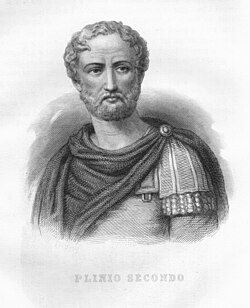
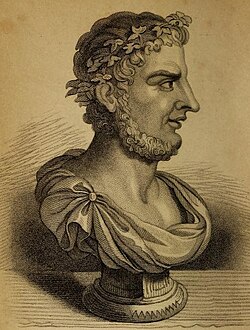
Pliny the Elder23–79history
Depiction · not a likeness
Avoid
In the middle of a passage on varieties of date: "the Jews, a nation remarkable for the contempt which they manifest of the divinities". The encyclopaedia of the ancient world, filing it under fruit.
There are numerous kinds of dates also, of a drier nature, which are long and slender, and sometimes of a curved shape. Those of this sort which we consecrate to the worship of the gods are called “chydæi” by the Jews, a nation remarkable for the contempt which they manifest of the divinities. Those found all over Thebais and Arabia are dry and small, with a shrivelled body: being parched up and scorched by the constant heat, they are covered with what more nearly resembles a shell than a skin. In Æthiopia the date is quite brittle even, so great is the driness of the climate; hence the people are able to knead it into a kind of bread, just like so much flour. It grows upon a shrub, with branches a cubit in length: it has a broad leaf, and the fruit is round, and larger than an apple. The name of this date is “coïx.” It comes to maturity in three years, and there is always fruit to be found upon the shrub, in various stages of maturity. The date of Thebais is at once packed in casks, with all its natural heat and freshness; for without this precaution, it quickly becomes vapid; it is of a poor, sickly taste, too, if it is not exposed, before it is eaten, to the heat of an oven.
The Natural History of Pliny, Volume 3 (of 6)open the book ↗
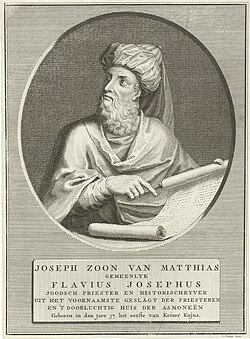
Flavius Josephus37–c. 100history
Depiction · not a likeness
Worth reading
The oldest surviving answer to an antisemitic libel. Josephus quotes Apion's accusation — that Jews swear an oath against Greeks — and takes it apart in front of the reader rather than ignoring it.
Apion also tells a false story, when he mentions an oath of ours, as if we "swore by God, the Maker of the heaven, and earth, and sea, to bear no good will to any foreigner, and particularly to none of the Greeks." Now this liar ought to have said directly that, "we would bear no good-will to any foreigner, and particularly to none of the Egyptians." For then his story about the oath would have squared with the rest of his original forgeries, in case our forefathers had been driven away by their kinsmen, the Egyptians, not on account of any wickedness they had been guilty of, but on account of the calamities they were under; for as to the Grecians, we were rather remote from them in place, than different from them in our institutions, insomuch that we have no enmity with them, nor any jealousy of them. On the contrary, it hath so happened that many of them have come over to our laws, and some of them have continued in their observation, although others of them had not courage enough to persevere, and so departed from them again; nor did any body ever hear this oath sworn by us: Apion, it seems, was the only person that heard it, for he indeed was the first composer of it.
"The stubborn superstition of its inhabitants" - Tacitus explaining why Jerusalem took so long to fall.
Vespasian had already broken the back of the Jewish war. Only the siege of Jerusalem remained. That this proved a difficult and laborious task was due rather to the high situation of the town and the stubborn superstition of its inhabitants than to any adequate provision enabling them to endure the hardships of the siege. Vespasian had, as we have already stated, three legions well tried in war. Four others were under Mucianus' command. Although these had never seen war, yet their envy of the neighbouring army's fame had banished sloth. Indeed, as the former were hardened by work and danger, so the latter owed their ardour to their unbroken inaction, and their shame at having no share in the war. Both generals had, besides auxiliary infantry and cavalry, foreign fleets and allied princes, and a fame that rested on widely differing claims. Vespasian was an indefatigable campaigner. He 5 headed the column, chose the camping-ground, never ceasing by night or day to use strategy, and, if need be, the sword to thwart the enemy. He eat what he could get, and dressed almost like a common soldier. Indeed, save for his avarice, he matched the generals of old days. Mucianus, on the other hand, was distinguished by his wealth and luxury, and his general superiority to the standards of a private person. He was the better speaker, and a skilful administrator and statesman. Their combined qualities would have made a fine emperor, if one could have blended their virtues and omitted their vices. Governing as they did the neighbouring provinces of Judaea and Syria, jealousy at first led to quarrels. However, on the death of Nero, they forgot their dislike and joined hands. It was their friends who first brought them together, and subsequently Titus became the chief bond of union and for the common good suppressed their ignoble jealousy. Both by nature and training he had charm to fascinate even such a man as Mucianus. The tribunes and centurions and the common soldiers were attracted, each according to his character, either by Titus' meritorious industry or by his gay indulgence in pleasure.
Rome's greatest historian breaks off his account of the siege of Jerusalem to explain the Jews to his readers. He collects the competing origin stories and settles on the one that makes them expelled plague-carriers.
… Others say that in the reign of Isis the superfluous population of Egypt, under the leadership of Hierosolymus and Juda, discharged itself upon the neighbouring districts, while there are many who think the Jews an Ethiopian stock, driven to migrate by their fear and dislike of King Cepheus. Another tradition makes them Assyrian refugees, who, lacking lands of their own, occupied a district of Egypt, and later took to building cities of their own and tilling Hebrew territory and the frontier-land of Syria. …
Since I am coming now to describe the last days of this famous city, it may not seem out of place to recount here its early history. It is said that the Jews are refugees from Crete, who settled on the confines of Libya at the time when Saturn was forcibly deposed by Jupiter. The evidence for this is sought in the name. Ida is a famous mountain in Crete inhabited by the Idaei, whose name became lengthened into the foreign form Judaei. Others say that in the reign of Isis the superfluous population of Egypt, under the leadership of Hierosolymus and Juda, discharged itself upon the neighbouring districts, while there are many who think the Jews an Ethiopian stock, driven to migrate by their fear and dislike of King Cepheus. Another tradition makes them Assyrian refugees, who, lacking lands of their own, occupied a district of Egypt, and later took to building cities of their own and tilling Hebrew territory and the frontier-land of Syria. Yet another version assigns to the Jews an illustrious origin as the descendants of the Solymi--a tribe famous in Homer--who founded the city and called it Hierosolyma after their own name.
Moses introduces a cult that is the opposite of all other religions: the pig, the fast, the leaven, the seventh day, each one explained as a memorial of disgrace.
To ensure his future hold over the people, Moses introduced a new 4 cult, which was the opposite of all other religions. All that we hold sacred they held profane, and allowed practices which we abominate. They dedicated in a shrine an image of the animal whose guidance had put an end to their wandering and thirst. They killed a ram, apparently as an insult to Ammon, and also sacrificed a bull, because the Egyptians worship the bull Apis. Pigs are subject to leprosy; so they abstain from pork in memory of their misfortune and the foul plague with which they were once infected. Their frequent fasts bear witness to the long famine they once endured, and, in token of the corn they carried off, Jewish bread is to this day made without leaven. They are said to have devoted the seventh day to rest, because that day brought an end to their troubles. Later, finding idleness alluring, they gave up the seventh year as well to sloth. Others maintain that they do this in honour of Saturn; either because their religious principles are derived from the Idaei, who are supposed to have been driven out with Saturn and become the ancestors of the Jewish people; or else because, of the seven constellations which govern the lives of men, the star of Saturn moves in the topmost orbit and exercises peculiar influence, and also because most of the heavenly bodies move round their courses in multiples of seven.
Then the verdict: their customs are impious and abominable, and their loyalty to one another is itself the charge against them. Nearly every later libel is already here, in a book that educated Europe read for eighteen centuries.
Whatever their origin, these rites are sanctioned by their antiquity. Their other customs are impious and abominable, and owe their prevalence to their depravity. For all the most worthless rascals, renouncing their national cults, were always sending money to swell the sum of offerings and tribute. This is one cause of Jewish prosperity. Another is that they are obstinately loyal to each other, and always ready to show compassion, whereas they feel nothing but hatred and enmity for the rest of the world. They eat and sleep separately. Though immoderate in sexual indulgence, they refrain from all intercourse with foreign women: among themselves anything is allowed. They have introduced circumcision to distinguish themselves from other people. Those who are converted to their customs adopt the same practice, and the first lessons they learn are to despise the gods, to renounce their country, and to think nothing of their parents, children, and brethren. However, they take steps to increase their numbers. They count it a crime to kill any of their later-born children, and they believe that the souls of those who die in battle or under persecution are immortal. Thus they think much of having children and nothing of facing death. They prefer to bury and not burn their dead. In this, as in their burial rites, and in their belief in an underworld, they conform to Egyptian custom. Their ideas of heaven are quite different. The Egyptians worship most of their gods as animals, or in shapes half animal and half human. The Jews acknowledge one god only, of whom they have a purely spiritual conception. They think it impious to make images of gods in human shape out of perishable materials. Their god is almighty and inimitable, without beginning and without end. They therefore set up no statues in their temples, nor even in their cities, refusing this homage both to their own kings and to the Roman emperors. However, the fact that their priests intoned to the flute and cymbals and wore wreaths of ivy, and that a golden vine was found in their temple has led some people to think that they worship Bacchus, who has so enthralled the East. But their cult would be most inappropriate. Bacchus instituted gay and cheerful rites, but the Jewish ritual is preposterous and morbid.
The Temple described from the outside, by a man who never went in and whose readers' army had burned it.
… Then, when Macedon waned, as the Parthian power was not yet ripe and Rome was still far away, they took kings of their own. The mob were fickle and drove them out. However, they recovered their throne by force; banished their countrymen, sacked cities, slew their brothers, wives, and parents, and committed all the usual kingly crimes. But this only fostered the hold of the Jewish religion, since the kings had strengthened their authority by assuming the priesthood.
The greater part of the population live in scattered villages, but 8 they also have towns. Jerusalem is the Jewish capital, and contained the temple, which was enormously wealthy. A first line of fortifications guarded the city, another the palace, and an innermost line enclosed the temple. None but a Jew was allowed as far as the doors: none but the priests might cross the threshold. When the East was in the hands of the Assyrians, Medes and Persians, they regarded the Jews as the meanest of their slaves. During the Macedonian ascendancy King Antiochus endeavoured to abolish their superstitions and to introduce Greek manners and customs. But Arsaces at that moment rebelled, and the Parthian war prevented him from effecting any improvement in the character of this grim people. Then, when Macedon waned, as the Parthian power was not yet ripe and Rome was still far away, they took kings of their own. The mob were fickle and drove them out. However, they recovered their throne by force; banished their countrymen, sacked cities, slew their brothers, wives, and parents, and committed all the usual kingly crimes. But this only fostered the hold of the Jewish religion, since the kings had strengthened their authority by assuming the priesthood.
Pompey walks into the Temple and finds nothing there: "their sanctuary was empty, their mysteries meaningless." The oldest surviving Roman verdict on a religion without images.
Cnaeus Pompeius was the first Roman to subdue the Jews and set foot 9 in their temple by right of conquest. It was then first realized that the temple contained no image of any god: their sanctuary was empty, their mysteries meaningless. The walls of Jerusalem were destroyed, but the temple was left standing. Later, during the Roman civil wars, when the eastern provinces had come under the control of Mark Antony, the Parthian Prince Pacorus seized Judaea, and was killed by Publius Ventidius. The Parthians were driven back over the Euphrates, and Caius Sosius subdued the Jews. Antony gave the kingdom to Herod, and Augustus, after his victory, enlarged it. After Herod's death, somebody called Simon, without awaiting the emperor's decision, forcibly assumed the title of king. He was executed by Quintilius Varus, who was Governor of Syria; the Jews were repressed and the kingdom divided between three of Herod's sons. Under Tiberius all was quiet. Caligula ordered them to put up his statue in the temple. They preferred war to that. But Caligula's death put an end to the rising. In Claudius' reign the kings had all either died or lost most of their territory. The emperor therefore made Judaea a province to be governed by Roman knights or freedmen. One of these, Antonius Felix, indulged in every kind of cruelty and immorality, wielding a king's authority with all the instincts of a slave. He had married Drusilla, a granddaughter of Antony and Cleopatra, so that he was Antony's grandson-in-law, while Claudius was Antony's grandson.
The Jews endured such oppression patiently until Gessius Florus - Tacitus granting the patience, and dating the revolt to a Roman governor rather than to Jewish character.
The Jews endured such oppression patiently until the time of 10 Gessius Florus, under whom war broke out. Cestius Gallus, the Governor of Syria, tried to crush it, but met with more reverses than victories. He died, either in the natural course or perhaps of disgust, and Nero sent out Vespasian, who, in a couple of campaigns, thanks to his reputation, good fortune, and able subordinates, had the whole of the country districts and all the towns except Jerusalem under the heel of his victorious army. The next year was taken up with civil war, and passed quietly enough as far as the Jews were concerned. But peace once restored in Italy, foreign troubles began again with feelings embittered on our side by the thought that the Jews were the only people who had not given in. At the same time it seemed best to leave Titus at the head of the army to meet the eventualities of the new reign, whether good or bad.
The portents before the fall of the Temple: "so sunk in superstition are the Jews and so opposed to all religious practices that they think it wicked to avert the threatened evil."
Various portents had occurred at this time, but so sunk in 13 superstition are the Jews and so opposed to all religious practices that they think it wicked to avert the threatened evil by sacrifices or vows. Embattled armies were seen to meet in the sky with flashing arms, and the temple shone with sudden fire from heaven. The doors of the shrine suddenly opened, a supernatural voice was heard calling the gods out, and at once there began a mighty movement of departure. Few took alarm at all this. Most people held the belief that, according to the ancient priestly writings, this was the moment at which the East was fated to prevail: they would now start forth from Judaea and conquer the world. This enigmatic prophecy really applied to Vespasian and Titus. But men are blinded by their hopes. The Jews took to themselves the promised destiny, and even defeat could not convince them of the truth. The number of the besieged, men and women of every age, is stated to have reached six hundred thousand. There were arms for all who could carry them, and far more were ready to fight than would be expected from their total numbers. The women were as determined as the men: if they were forced to leave their homes they had more to fear in life than in death.
Tiberius burning the vestments and the sacred vessels, and sending the Jewish youths to provinces with an unhealthy climate under pretence of military service.
XXXVI. He suppressed all foreign religions, and the Egyptian and Jewish rites, obliging those who practised that kind of superstition, to burn their vestments, and all their sacred utensils. He distributed the Jewish youths, under the pretence of military service, among the provinces noted for an unhealthy climate; and dismissed from the city all the rest of that nation as well as those who were proselytes to that religion , under pain of slavery for life, unless they complied. He also expelled the astrologers; but upon their suing for pardon, and promising to renounce their profession, he revoked his decree.
Claudius "banished from Rome all the Jews, who were continually making disturbances at the instigation of one Chrestus" - the sentence historians have argued over for four hundred years, and the first Roman expulsion on record.
He banished from Rome all the Jews, who were continually making disturbances at the instigation of one Chrestus . He allowed the ambassadors of the Germans to sit at the public spectacles in the seats assigned to the senators, being induced to grant them favours by their frank and honourable conduct. For, having been seated in the rows of benches which were common to the people, on observing the Parthian and Armenian ambassadors sitting among the senators, they took upon themselves to cross over into the same seats, as being, they said, no way inferior to the others, in point either, of merit or rank. The religious rites of the Druids, solemnized with such horrid cruelties, which had only been forbidden the citizens of Rome during the reign of Augustus, he utterly abolished among the Gauls . On the other hand, he attempted to transfer the Eleusinian mysteries from Attica to Rome . He likewise ordered the temple of Venus Erycina in Sicily, which was old and in a ruinous condition, to be repaired at the expense of the Roman people. He concluded treaties with foreign princes in the forum, with the sacrifice of a sow, and the form of words used by the heralds in former times. But in these and other things, and indeed the greater part of his administration, he was directed not so much by his own judgment, as by the influence of his wives and freedmen; for the most part acting in conformity to what their interests or fancies dictated.
Rome's sharpest satirist on Jewish converts: the sabbath as sloth, circumcision, and the charge that was made against Jews for the next nineteen centuries — that they keep their own law above the country's.
Some whose lot it is to have a father that reveres sabbaths, worship nothing save clouds and the divinity of heaven; and think that flesh of swine, from which their sire abstained, differs in naught from that of man. Soon, too, they submit to circumcision. But, trained to look with scorn upon the laws of Rome, they study and observe and reverence all those Jewish statutes that Moses in his mystic volume handed down: never to show the road except to one that worships the same sacred rites--to conduct to the spring they are in quest of, the circumcised alone. But their father is to blame for this; to whom each seventh day was a day of sloth, and kept aloof from all share of life's daily duties.
The charge that Jews had falsified their own scripture to spite Christians was standing doctrine for centuries. Augustine, who had every reason to take it up, refuses it — and says the accusation makes no sense.
But if I say this, I shall presently be answered, It is one of the Jews' lies. This, however, we have disposed of above, showing that it cannot be that men of so just a reputation as the seventy translators should have falsified their version. However, if I ask them which of the two is more credible, that the Jewish nation, scattered far and wide, could have unanimously conspired to forge this lie, and so, through envying others the authority of their Scriptures, have deprived themselves of their verity; or that seventy men, who were also themselves Jews, shut up in one place (for Ptolemy king of Egypt had got them together for this work), should have envied foreign nations that same truth, and by common consent inserted these errors: who does not see which can be more naturally and readily believed? But far be it from any prudent man to believe either that the Jews, however malicious and wrong-headed, could have tampered with so many and so widely-dispersed manuscripts; or that those renowned seventy individuals had any common purpose to grudge the truth to the nations. One must therefore more plausibly maintain, that when first their labours began to be transcribed from the copy in Ptolemy's library, some such misstatement might find its way into the first copy made, and from it might be disseminated far and wide; and that this might arise from no fraud, but from a mere copyist's error. This is a sufficiently plausible account of the difficulty regarding Methuselah's life, and of that other case in which there is a difference in the total of twenty-four years. But in those cases in which there is a methodical resemblance in the falsification, so that uniformly the one version allots to the period before a son and successor is born 100 years more than the other, and to the period subsequent 100 years less, and vice versâ, so that the totals may agree,--and this holds true of the first, second, third, fourth, fifth, and seventh generations,--in these cases error seems to have, if we may say so, a certain kind of constancy, and savours not of accident, but of design.
Seneca on the sabbath: they lose through idleness about the seventh part of their life. Seneca's own book on superstition is lost, and this is how the passage reached us - quoted by a Christian bishop three centuries later to agree with it.
… with the sacred things of the Jews, and especially the sabbaths, affirming that they act uselessly in keeping those seventh days, whereby they lose through idleness about the seventh part of their life, and also many things which demand immediate attention are damaged. The Christians, however, who were already most hostile to the Jews, he did not dare to mention, either for praise or blame, lest, if he praised them, he should do so against the ancient custom of his country, or, perhaps, if he should blame them, he should do so against his own will.
Seneca, among the other superstitions of civil theology, also found fault with the sacred things of the Jews, and especially the sabbaths, affirming that they act uselessly in keeping those seventh days, whereby they lose through idleness about the seventh part of their life, and also many things which demand immediate attention are damaged. The Christians, however, who were already most hostile to the Jews, he did not dare to mention, either for praise or blame, lest, if he praised them, he should do so against the ancient custom of his country, or, perhaps, if he should blame them, he should do so against his own will.
Augustine quoting Seneca on "that most accursed nation" whose customs the conquerors had taken up. Seneca's own book is lost; this quotation is how the line survived.
When he was speaking concerning those Jews, he said, "When, meanwhile, the customs of that most accursed nation have gained such strength that they have been now received in all lands, the conquered have given laws to the conquerors." By these words he expresses his astonishment; and, not knowing what the providence of God was leading him to say, subjoins in plain words an opinion by which he showed what he thought about the meaning of those sacred institutions: "For," he says, "those, however, know the cause of their rites, whilst the greater part of the people know not why they perform theirs." But concerning the solemnities of the Jews, either why or how far they were instituted by divine authority, and afterwards, in due time, by the same authority taken away from the people of God, to whom the mystery of eternal life was revealed, we have both spoken elsewhere, especially when we were treating against the Manichæans, and also intend to speak in this work in a more suitable place.
The Hebrew people gathered into one republic to carry a mystery it did not understand. The witness doctrine in its gentlest form, and the root of a thousand years of policy.
This mystery of eternal life, even from the beginning of the human race, was, by certain signs and sacraments suitable to the times, announced through angels to those to whom it was meet. Then the Hebrew people was congregated into one republic, as it were, to perform this mystery; and in that republic was foretold, sometimes through men who understood what they spake, and sometimes through men who understood not, all that had transpired since the advent of Christ until now, and all that will transpire. This same nation, too, was afterwards dispersed through the nations, in order to testify to the scriptures in which eternal salvation in Christ had been declared. For not only the prophecies which are contained in words, nor only the precepts for the right conduct of life, which teach morals and piety, and are contained in the sacred writings,--not only these, but also the rites, priesthood, tabernacle or temple, altars, sacrifices, ceremonies, and whatever else belongs to that service which is due to God, and which in Greek is properly called λατρεία,--all these signified and fore-announced those things which we who believe in Jesus Christ unto eternal life believe to have been fulfilled, or behold in process of fulfilment, or confidently believe shall yet be fulfilled.
Abraham the Jew introduced: a very rich merchant, "a very honest and trusty man", and the great friend of a Christian. The tale sets him up as the better man before it starts.
… He had particular friendship for a very rich Jew called Abraham, who was also a merchant and a very honest and trusty man, and seeing the latter's worth and loyalty, it began to irk him sore that the soul of so worthy and discreet and good a man should go to perdition for default of faith; wherefore he fell to beseeching him on friendly wise leave the errors of the Jewish faith and turn to the Christian verity, which he might see still wax and prosper, as being holy and good, whereas his own faith, on the contrary, was manifestly on the wane and dwindling to nought. The Jew made answer that he held no faith holy or good save only the Jewish, that in this latter he was born and therein meant to live and die, nor should aught ever make him remove therefrom.
As I have heard tell, gracious ladies, there was once in Paris a great merchant and a very loyal and upright man, whose name was Jehannot de Chevigné and who was of great traffic in silks and stuffs. He had particular friendship for a very rich Jew called Abraham, who was also a merchant and a very honest and trusty man, and seeing the latter's worth and loyalty, it began to irk him sore that the soul of so worthy and discreet and good a man should go to perdition for default of faith; wherefore he fell to beseeching him on friendly wise leave the errors of the Jewish faith and turn to the Christian verity, which he might see still wax and prosper, as being holy and good, whereas his own faith, on the contrary, was manifestly on the wane and dwindling to nought. The Jew made answer that he held no faith holy or good save only the Jewish, that in this latter he was born and therein meant to live and die, nor should aught ever make him remove therefrom.
Jehannot arguing Christianity at Abraham, who is a past master in his own law and unmoved.
… Like as he abode obstinate, even so Jehannot never gave over importuning him, till at last the Jew, overcome by such continual insistence, said, 'Look you, Jehannot, thou wouldst have me become a Christian and I am disposed to do it; insomuch, indeed, that I mean, in the first place, to go to Rome and there see him who, thou sayest, is God's Vicar upon earth and consider his manners and fashions and likewise those of his chief brethren. If these appear to me such that I may, by them, as well as by your words, apprehend that your faith is better than mine, even as thou hast studied to show me, I will do as I have said; and if it be not so, I will remain a Jew as I am.'
Jehannot for all that desisted not from him, but some days after returned to the attack with similar words, showing him, on rude enough wise (for that merchants for the most part can no better), for what reasons our religion is better than the Jewish; and albeit the Jew was a past master in their law, nevertheless, whether it was the great friendship he bore Jehannot that moved him or peradventure words wrought it that the Holy Ghost put into the good simple man's mouth, the latter's arguments began greatly to please him; but yet, persisting in his own belief, he would not suffer himself to be converted. Like as he abode obstinate, even so Jehannot never gave over importuning him, till at last the Jew, overcome by such continual insistence, said, 'Look you, Jehannot, thou wouldst have me become a Christian and I am disposed to do it; insomuch, indeed, that I mean, in the first place, to go to Rome and there see him who, thou sayest, is God's Vicar upon earth and consider his manners and fashions and likewise those of his chief brethren. If these appear to me such that I may, by them, as well as by your words, apprehend that your faith is better than mine, even as thou hast studied to show me, I will do as I have said; and if it be not so, I will remain a Jew as I am.'
What Abraham saw in Rome - gluttons, drunkards, covetous, trafficking in Christian blood and holy things alike. The indictment of the Church is put in a Jew's mouth, which is the only way it could be printed.
Moreover, he manifestly perceived them to be universally gluttons, wine-bibbers, drunkards and slaves to their bellies, brute-beast fashion, more than to aught else after lust. And looking farther, he saw them all covetous and greedy after money, insomuch that human, nay, Christian blood, no less than things sacred, whatsoever they might be, whether pertaining to the sacrifices of the altar or to the benefices of the church, they sold and bought indifferently for a price, making a greater traffic and having more brokers thereof than folk at Paris of silks and stuffs or what not else. Manifest simony they had christened 'procuration' and gluttony 'sustentation,' as if God apprehended not,--let be the meaning of words but,--the intention of depraved minds and would suffer Himself, after the fashion of men, to be duped by the names of things. All this, together with much else which must be left unsaid, was supremely displeasing to the Jew, who was a sober and modest man, and himseeming he had seen enough, he determined to return to Paris and did so.
Abraham the Jew goes to Rome to inspect the Church before converting, finds it rotten through, and converts anyway — on the reasoning that a religion surviving that much corruption must be held up by God. The Jew is the sharpest man in the story, and the story still ends in a font.
… Whereto the Jew promptly answered, 'Meseemeth, God give them ill one and all! And I say this for that, if I was able to observe aright, no piety, no devoutness, no good work or example of life or otherwhat did I see there in any who was a churchman; nay, but lust, covetise, gluttony and the like and worse (if worse can be) meseemed to be there in such favour with all that I hold it for a forgingplace of things diabolical rather than divine. And as far as I can judge, meseemeth your chief pastor and consequently all the others endeavour with all diligence and all their wit and every art to bring to nought and banish from the world the Christian religion, whereas they should be its foundation and support. …
As soon as Jehannot knew of his return, he betook himself to him, hoping nothing less than that he should become a Christian, and they greeted each other with the utmost joy. Then, after Abraham had rested some days, Jehannot asked him how himseemed of the Holy Father and of the cardinals and others of his court. Whereto the Jew promptly answered, 'Meseemeth, God give them ill one and all! And I say this for that, if I was able to observe aright, no piety, no devoutness, no good work or example of life or otherwhat did I see there in any who was a churchman; nay, but lust, covetise, gluttony and the like and worse (if worse can be) meseemed to be there in such favour with all that I hold it for a forgingplace of things diabolical rather than divine. And as far as I can judge, meseemeth your chief pastor and consequently all the others endeavour with all diligence and all their wit and every art to bring to nought and banish from the world the Christian religion, whereas they should be its foundation and support. And for that I see that this whereafter they strive cometh not to pass, but that your religion continually increaseth and waxeth still brighter and more glorious, meseemeth I manifestly discern that the Holy Spirit is verily the foundation and support thereof, as of that which is true and holy over any other. Wherefore, whereas, aforetime I abode obdurate and insensible to thine exhortations and would not be persuaded to embrace thy faith, I now tell thee frankly that for nothing in the world would I forbear to become a Christian. Let us, then, to church and there have me baptized, according to the rite and ordinance of your holy faith.'
The Prioress tells a blood libel as a miracle story, and the Canterbury pilgrims hear it without objection. It is the single most-read piece of English literature in which the accusation is simply assumed to be true.
There was in Asia, in a great city, Amonges Christian folk, a Jewery, Sustained by a lord of that country, For foul usure, and lucre of villainy, Hateful to Christ, and to his company; And through the street men mighte ride and wend, For it was free, and open at each end.
"The Jews, a people than whom none more obstinate" - one clause, in passing, from the most humane man of his generation. It is here because that is how most of it travelled: not as a tract, as an aside.
The apostles also confuted the heathen philosophers and Jews, a people than whom none more obstinate, but rather by their good lives and miracles than syllogisms: and yet there was scarce one among them that was capable of understanding the least "quodlibet" of the Scotists. But now, where is that heathen or heretic that must not presently stoop to such wire-drawn subtleties, unless he be so thick-skulled that he can't apprehend them, or so impudent as to hiss them down, or, being furnished with the same tricks, be able to make his party good with them? As if a man should set a conjurer on work against a conjurer, or fight with one hallowed sword against another, which would prove no other than a work to no purpose. For my own part I conceive the Christians would do much better if instead of those dull troops and companies of soldiers with which they have managed their war with such doubtful success, they would send the bawling Scotists, the most obstinate Occamists, and invincible Albertists to war against the Turks and Saracens; and they would see, I guess, a most pleasant combat and such a victory as was never before. For who is so faint whom their devices will not enliven? who so stupid whom such spurs can't quicken? or who so quick-sighted before whose eyes they can't cast a mist?
Luther's notorious tract of 1543 is not in the public-domain corpus this page is built from, so what stands here is the same man in his Genesis lectures, where the charge of deicide is put in passing, as settled fact.
… On these they fix their eyes as on leaders and lights of the Church, and inquire of their doctrine for the confirmation of their faith. In a word they venerate them as their fathers; that is, as teachers of all who call upon Jesus Christ; and they understand also that these same patriarchs are the fathers in the flesh of those murderers, the Jews, and of others who, like the Jews of old, hold up Christ for a laughing-stock and "crucify him afresh" day by day.
Before this, when the people heard the names of these luminaries of the Church, they had no particular thoughts upon their spiritual excellencies or their heroism; nor did they consider them to be above the common rank of shepherds; but now, they learn to acknowledge the peculiar presence of God with them, and to render thanks unto God that they were called of him and that they so wonderfully governed and revived the Church. From these also they have borrowed eminent examples of the fear of God, of faith, of confession, of patience, and of many other holy virtues. On these they fix their eyes as on leaders and lights of the Church, and inquire of their doctrine for the confirmation of their faith. In a word they venerate them as their fathers; that is, as teachers of all who call upon Jesus Christ; and they understand also that these same patriarchs are the fathers in the flesh of those murderers, the Jews, and of others who, like the Jews of old, hold up Christ for a laughing-stock and "crucify him afresh" day by day.
Luther, for once, understanding why converts from Judaism could not break with the Law at once, and saying God bore with them.
When we consider the obstinacy with which Romanists cling to their traditions, we can very well understand the zealous devotion of the Jews for the Law. After all, they had received the Law from God. We can understand how impossible it was for recent converts from Judaism suddenly to break with the Law. For that matter, God did bear with them, as He bore with the infirmity of Israel when the people halted between two religions. Was not God patient with us also while we were blindfolded by the papacy? God is longsuffering and full of mercy. But we dare not abuse the patience of the Lord. We dare no longer continue in error now that the truth has been revealed in the Gospel. The opponents of Paul had his own example to prefer against him. Paul had circumcised Timothy. Paul defended his action on the ground that he had circumcised Timothy, not from compulsion, but from Christian love, lest the weak in faith should be offended. His opponents would not accept Paul’s explanation.
"To live as a Jew is nothing bad ... But to play the Jew, and for conscience' sake to abstain from certain meats, is a denial of Christ."
To live as a Jew is nothing bad. To eat or not to eat pork, what difference does it make? But to play the Jew, and for conscience’ sake to abstain from certain meats, is a denial of Christ. When Paul saw that Peter’s attitude tended to this, he withstood Peter and said to him: “You know that the observance of the Law is not needed unto righteousness. You know that we are justified by faith in Christ. You know that we may eat all kinds of meats. Yet by your example you obligate the Gentiles to forsake Christ, and to return to the Law. You give them reason to think that faith is not sufficient unto salvation.”
Luther putting words in a Jewish mouth: "When we Jews compare ourselves with the Gentiles, we look pretty good." The ventriloquism is the method of the whole commentary.
“When we Jews compare ourselves with the Gentiles, we look pretty good. We have the Law, we have good works. Our rectitude dates from our birth, because the Jewish religion is natural to us. But all this does not make us righteous before God.” Peter and the others lived up to the requirements of the Law. They had circumcision, the covenant, the promises, the apostleship. But because of these advantages they were not to think themselves righteous before God. None of these prerogatives spell faith in Christ, which alone can justify a person. We do not mean to imply that the Law is bad. We do not condemn the Law, circumcision, etc., for their failure to justify us. Paul spoke disparagingly of these ordinances, because the false apostles asserted that mankind is saved by them without faith. Paul could not let this assertion stand, for without faith all things are deadly.
"The Jews misconstrue this passage." The standing verdict of the commentary, in five words.
The Jews misconstrue this passage. They want the term “to bless” to mean “to praise.” They want the passage to read: In thee shall all the nations of the earth be praised. But this is a perversion of the words of Holy Writ. With the words “Abraham believed” Paul describes a spiritual Abraham, renewed by faith and regenerated by the Holy Ghost, that he should be the spiritual father of many nations. In that way all the Gentiles could be given to him for an inheritance.
Machiavel speaks the prologue and hands the audience Barabas as his disciple, before the Jew has said a word.
… Hence comes it that a strong-built citadel Commands much more than letters can import: Which maxim had Phalaris observ'd, H'ad never bellow'd, in a brazen bull, Of great ones' envy: o' the poor petty wights Let me be envied and not pitied. But whither am I bound? I come not, I, To read a lecture here in Britain, But to present the tragedy of a Jew, Who smiles to see how full his bags are cramm'd; Which money was not got without my means. I crave but this,--grace him as he deserves, And let him not be entertain'd the worse Because he favours me. [Exit.]
MACHIAVEL. Albeit the world think Machiavel is dead, Yet was his soul but flown beyond the Alps; And, now the Guise is dead, is come from France, To view this land, and frolic with his friends. To some perhaps my name is odious; But such as love me, guard me from their tongues, And let them know that I am Machiavel, And weigh not men, and therefore not men's words. Admir'd I am of those that hate me most: Though some speak openly against my books, Yet will they read me, and thereby attain To Peter's chair; and, when they cast me off, Are poison'd by my climbing followers. I count religion but a childish toy, And hold there is no sin but ignorance. Birds of the air will tell of murders past! I am asham'd to hear such fooleries. Many will talk of title to a crown: What right had Caesar to the empery? Might first made kings, and laws were then most sure When, like the Draco's, they were writ in blood. Hence comes it that a strong-built citadel Commands much more than letters can import: Which maxim had Phalaris observ'd, H'ad never bellow'd, in a brazen bull, Of great ones' envy: o' the poor petty wights Let me be envied and not pitied. But whither am I bound? I come not, I, To read a lecture here in Britain, But to present the tragedy of a Jew, Who smiles to see how full his bags are cramm'd; Which money was not got without my means. I crave but this,--grace him as he deserves, And let him not be entertain'd the worse Because he favours me. [Exit.]
Barabas counting his money in the first scene, and reading his own wealth as the blessing promised to the Jews.
… Making the sea[s] their servants, and the winds To drive their substance with successful blasts? Who hateth me but for my happiness? Or who is honour'd now but for his wealth? Rather had I, a Jew, be hated thus, Than pitied in a Christian poverty; For I can see no fruits in all their faith, But malice, falsehood, and excessive pride, Which methinks fits not their profession. Haply some hapless man hath conscience, And for his conscience lives in beggary. They say we are a scatter'd nation: I cannot tell; but we have scambled up More wealth by far than those that brag of faith: There's Kirriah Jairim, the great Jew of Greece, Obed in Bairseth, Nones in Portugal, Myself in Malta, some in Italy, Many in France, and wealthy every one; Ay, wealthier far than any Christian. …
BARABAS. Thus trolls our fortune in by land and sea, And thus are we on every side enrich'd: These are the blessings promis'd to the Jews, And herein was old Abraham's happiness: What more may heaven do for earthly man Than thus to pour out plenty in their laps, Ripping the bowels of the earth for them, Making the sea[s] their servants, and the winds To drive their substance with successful blasts? Who hateth me but for my happiness? Or who is honour'd now but for his wealth? Rather had I, a Jew, be hated thus, Than pitied in a Christian poverty; For I can see no fruits in all their faith, But malice, falsehood, and excessive pride, Which methinks fits not their profession. Haply some hapless man hath conscience, And for his conscience lives in beggary. They say we are a scatter'd nation: I cannot tell; but we have scambled up More wealth by far than those that brag of faith: There's Kirriah Jairim, the great Jew of Greece, Obed in Bairseth, Nones in Portugal, Myself in Malta, some in Italy, Many in France, and wealthy every one; Ay, wealthier far than any Christian. I must confess we come not to be kings: That's not our fault: alas, our number's few! And crowns come either by succession, Or urg'd by force; and nothing violent, Oft have I heard tell, can be permanent. Give us a peaceful rule; make Christians kings, That thirst so much for principality. I have no charge, nor many children, But one sole daughter, whom I hold as dear As Agamemnon did his Iphigen; And all I have is hers.--But who comes here?
Barabas was the model Shakespeare worked against. The play gives him real grievances and then makes him a poisoner of nuns.
BARABAS. In spite of these swine-eating Christians, (Unchosen nation, never circumcis'd, Poor villains, such as were ne'er thought upon Till Titus and Vespasian conquer'd us,) Am I become as wealthy as I was. They hop'd my daughter would ha' been a nun; But she's at home, and I have bought a house As great and fair as is the governor's: And there, in spite of Malta, will I dwell, Having Ferneze's hand; whose heart I'll have, Ay, and his son's too, or it shall go hard. I am not of the tribe of Levi, I, That can so soon forget an injury. We Jews can fawn like spaniels when we please; And when we grin we bite; yet are our looks As innocent and harmless as a lamb's. I learn'd in Florence how to kiss my hand, Heave up my shoulders when they call me dog, And duck as low as any bare-foot friar; Hoping to see them starve upon a stall, Or else be gather'd for in our synagogue, That, when the offering-basin comes to me, Even for charity I may spit into't.-- Here comes Don Lodowick, the governor's son, One that I love for his good father's sake.
Before the bond is signed, Shylock itemises what Antonio has done to him in the Rialto: rated, spat on, called misbeliever and cut-throat dog.
SHYLOCK. Signior Antonio, many a time and oft In the Rialto you have rated me About my moneys and my usances. Still have I borne it with a patient shrug, (For suff’rance is the badge of all our tribe.) You call me misbeliever, cut-throat dog, And spet upon my Jewish gaberdine, And all for use of that which is mine own. Well then, it now appears you need my help. Go to, then, you come to me, and you say “Shylock, we would have moneys.” You say so: You that did void your rheum upon my beard, And foot me as you spurn a stranger cur Over your threshold, moneys is your suit. What should I say to you? Should I not say “Hath a dog money? Is it possible A cur can lend three thousand ducats?” Or Shall I bend low and, in a bondman’s key, With bated breath and whisp’ring humbleness, Say this: “Fair sir, you spet on me on Wednesday last; You spurn’d me such a day; another time You call’d me dog; and for these courtesies I’ll lend you thus much moneys”?
Spoken by the villain of the play, and still the most quoted defence of Jewish humanity in English. Both of those are true of it, and the page is not going to resolve that for you.
… Hath not a Jew eyes? Hath not a Jew hands, organs, dimensions, senses, affections, passions? Fed with the same food, hurt with the same weapons, subject to the same diseases, healed by the same means, warmed and cooled by the same winter and summer as a Christian is? If you prick us, do we not bleed? If you tickle us, do we not laugh? If you poison us, do we not die? And if you wrong us, shall we not revenge? If we are like you in the rest, we will resemble you in that. If a Jew wrong a Christian, what is his humility? Revenge. …
SHYLOCK. To bait fish withal; if it will feed nothing else, it will feed my revenge. He hath disgrac’d me and hind’red me half a million, laugh’d at my losses, mock’d at my gains, scorned my nation, thwarted my bargains, cooled my friends, heated mine enemies. And what’s his reason? I am a Jew. Hath not a Jew eyes? Hath not a Jew hands, organs, dimensions, senses, affections, passions? Fed with the same food, hurt with the same weapons, subject to the same diseases, healed by the same means, warmed and cooled by the same winter and summer as a Christian is? If you prick us, do we not bleed? If you tickle us, do we not laugh? If you poison us, do we not die? And if you wrong us, shall we not revenge? If we are like you in the rest, we will resemble you in that. If a Jew wrong a Christian, what is his humility? Revenge. If a Christian wrong a Jew, what should his sufferance be by Christian example? Why, revenge! The villainy you teach me I will execute, and it shall go hard but I will better the instruction.
Excommunicated by his own community at twenty-three, and then the coolest reader the Hebrew Bible has ever had. The chosenness, he argues, was a territory and a constitution, and both ended with the state.
Next I inquired, why the Hebrews were called God's chosen people, and discovering that it was only because God had chosen for them a certain strip of territory, where they might live peaceably and at ease, I learnt that the Law revealed by God to Moses was merely the law of the individual Hebrew state, therefore that it was binding on none but Hebrews, and not even on Hebrews after the downfall of their nation. Further, in order to ascertain, whether it could be concluded from Scripture, that the human understanding is naturally corrupt, I inquired whether the Universal Religion, the Divine Law revealed through the Prophets and Apostles to the whole human race, differs from that which is taught by the light of natural reason, whether miracles can take place in violation of the laws of nature, and if so, whether they imply the existence of God more surely and clearly than events, which we understand plainly and distinctly through their immediate natural causes.
The Hebrew state as the case study in how religion acquires the force of law. He is not defending or attacking; he is dismantling.
From these considerations I pass on to the Hebrew State, which I describe at some length, in order to trace the manner in which Religion acquired the force of law, and to touch on other noteworthy points. I then prove, that the holders of sovereign power are the depositories and interpreters of religious no less than of civil ordinances, and that they alone have the right to decide what is just or unjust, pious or impious; lastly, I conclude by showing, that they best retain this right and secure safety to their state by allowing every man to think what he likes, and say what he thinks.
Venice, 1645. Evelyn is invited to a bris by a Jewish acquaintance and writes down the instruments, the incense, the paper cap, the five Books of Moses on the cupboard - and then, in the same breath, the verdict. The yellow hats he mentions were compulsory, imposed by papal decree; he records them as a fact about the wearers.
… Before this, with profound reverence, and mumbling a few words, he waved the child to and fro awhile; then he delivered it to another Rabbi, who sat all this time upon a table. While the ceremony was performing, all the company fell singing a Hebrew hymn, in a barbarous tone, waving themselves to and fro; a ceremony they observe in all their devotions.--The Jews in Rome all wear yellow hats, live only upon brokage and usury, very poor and despicable, beyond what they are in other territories of Princes where they are permitted.
I went to the Ghetto, where the Jews dwell as in a suburb by themselves; being invited by a Jew of my acquaintance to see a circumcision. I passed by the Piazza Judea, where their seraglio begins; for, being environed with walls, they are locked up every night. In this place remains yet part of a stately fabric, which my Jew told me had been a palace of theirs for the ambassador of their nation, when their country was subject to the Romans. Being led through the Synagogue into a private house, I found a world of people in a chamber: by and by came an old man, who prepared and laid in order divers instruments brought by a little child of about seven years old in a box. These the man laid in a silver basin; the knife was much like a short razor to shut into the half. Then they burnt some incense in a censer, which perfumed the room all the while the ceremony was performing. In the basin was a little cap made of white paper like a capuchin's hood, not bigger than the finger: also a paper of a red astringent powder, I suppose of bole; a small instrument of silver, cleft in the middle at one end, to take up the prepuce withal; a fine linen cloth wrapped up. These being all in order, the women brought the infant swaddled, out of another chamber, and delivered it to the Rabbi, who carried and presented it before an altar, or cupboard, dressed up, on which lay the five Books of Moses, and the Commandments, a little unrolled. Before this, with profound reverence, and mumbling a few words, he waved the child to and fro awhile; then he delivered it to another Rabbi, who sat all this time upon a table. While the ceremony was performing, all the company fell singing a Hebrew hymn, in a barbarous tone, waving themselves to and fro; a ceremony they observe in all their devotions.--The Jews in Rome all wear yellow hats, live only upon brokage and usury, very poor and despicable, beyond what they are in other territories of Princes where they are permitted.
Pepys walked into Bevis Marks on Simchas Torah — the one day of the year the Torah is carried round the room and danced with — and recorded it as proof that the Jews had no religion. England had readmitted them seven years earlier, and this is the first full English eyewitness account.
… But, Lord! to see the disorder, laughing, sporting, and no attention, but confusion in all their service, more like brutes than people knowing the true God, would make a man forswear ever seeing them more and indeed I never did see so much, or could have imagined there had been any religion in the whole world so absurdly performed as this. Away thence with my mind strongly disturbed with them, by coach and set down my wife in Westminster Hall, and I to White Hall, and there the Tangier Committee met, but the Duke and the Africa Committee meeting in our room, Sir G. …
after dinner my wife and I, by Mr. Rawlinson’s conduct, to the Jewish Synagogue: where the men and boys in their vayles, and the women behind a lattice out of sight; and some things stand up, which I believe is their Law, in a press to which all coming in do bow; and at the putting on their vayles do say something, to which others that hear him do cry Amen, and the party do kiss his vayle. Their service all in a singing way, and in Hebrew. And anon their Laws that they take out of the press are carried by several men, four or five several burthens in all, and they do relieve one another; and whether it is that every one desires to have the carrying of it, I cannot tell, thus they carried it round about the room while such a service is singing. And in the end they had a prayer for the King, which they pronounced his name in Portugall; but the prayer, like the rest, in Hebrew. But, Lord! to see the disorder, laughing, sporting, and no attention, but confusion in all their service, more like brutes than people knowing the true God, would make a man forswear ever seeing them more and indeed I never did see so much, or could have imagined there had been any religion in the whole world so absurdly performed as this. Away thence with my mind strongly disturbed with them, by coach and set down my wife in Westminster Hall, and I to White Hall, and there the Tangier Committee met, but the Duke and the Africa Committee meeting in our room, Sir G. Carteret; Sir W. Compton,
The Jew of Roxana, in a kind of rage, who exists to menace the heroine and be outwitted. Defoe's merchant is the stock figure doing the stock work.
… I began to be a little surprised at what the Jew had said, you may be sure, and eager to know what he meant, and was very impatient till the Dutch merchant came back, and that so impatient that I called one of his servants to let him know I desired to speak with him. When he came in I asked his pardon for being so impatient, but told him I could not be easy till he had told me what the meaning of all this was. "Why, madam," says the Dutch merchant, "in short, the meaning is what I am surprised at too. …
The Jew understood me presently, continuing in a kind of rage, and spoke in French: "Yes, madam, it does concern you much, very much, very much," repeating the words, shaking his head; and then turning to the Dutchman, "Sir," says he, "pray tell her what is the case." "No," says the merchant, "not yet; let us talk a little farther of it by ourselves;" upon which they withdrew into another room, where still they talked very high, but in a language I did not understand. I began to be a little surprised at what the Jew had said, you may be sure, and eager to know what he meant, and was very impatient till the Dutch merchant came back, and that so impatient that I called one of his servants to let him know I desired to speak with him. When he came in I asked his pardon for being so impatient, but told him I could not be easy till he had told me what the meaning of all this was. "Why, madam," says the Dutch merchant, "in short, the meaning is what I am surprised at too. This man is a Jew, and understands jewels perfectly well, and that was the reason I sent for him, to dispose of them to him for you; but as soon as he saw them, he knew the jewels very distinctly, and flying out in a passion, as you see he did, told me, in short, that they were the very parcel of jewels which the English jeweller had about him who was robbed going to Versailles, about eight years ago, to show them the Prince de ----, and that it was for these very jewels that the poor gentleman was murdered; and he is in all this agony to make me ask you how you came by them; and he says you ought to be charged with the robbery and murder, and put to the question to discover who were the persons that did it, that they might be brought to justice." While he said this the Jew came impudently back into the room without calling, which a little surprised me again.
The Fortunate Mistress (Parts 1 and 2): or a History of the Life of Mademoiselle de Beleau Known by the Name of the Lady Roxanaopen the book ↗
XVIII century
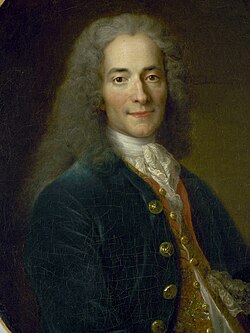
Voltaire1694–1778philosophy
Avoid
The Jews as late-comers who invented a descent from Abraham to relieve themselves of being strangers, hated and despised by their neighbours.
The temerity of the human understanding has even gone so far as to imagine that the Jews did not call themselves the descendants of Abraham until a very late period, when they had at last established themselves in Palestine. They were strangers, hated and despised by their neighbors. They wished, say some, to relieve themselves by passing for descendants of that Abraham who was so much reverenced in a great part of Asia. The faith which we owe to the sacred books of the Jews removes all these difficulties.
"The Jews, our masters and our enemies, whom we believe and whom we detest." He is naming the double bind he is in with the book he cannot throw away, and the contempt is not hidden.
Abraham is one of those names which were famous in Asia Minor and Arabia, as Thaut was among the Egyptians, the first Zoroaster in Persia, Hercules in Greece, Orpheus in Thrace, Odin among the northern nations, and so many others, known more by their fame than by any authentic history. I speak here of profane history only; as for that of the Jews, our masters and our enemies, whom we at once detest and believe, their history having evidently been written by the Holy Ghost, we feel toward it as we ought to feel. We have to do here only with the Arabs. They boast of having descended from Abraham through Ishmael, believing that this patriarch built Mecca and died there. The fact is, that the race of Ishmael has been infinitely more favored by God than has that of Jacob. Both races, it is true, have produced robbers; but the Arabian robbers have been prodigiously superior to the Jewish ones; the descendants of Jacob conquered only a very small country, which they have lost, whereas the descendants of Ishmael conquered parts of Asia, of Europe, and of Africa, established an empire more extensive than that of the Romans, and drove the Jews from their caverns, which they called The Land of Promise.
His standing formula for them. He uses it to deny them any antiquity, which was the point: an ancient people has claims, a horde has none.
It is difficult to penetrate the shades of antiquity; but it is evident that all the kingdoms of Asia were in a very flourishing state before the wandering horde of Arabs, called Jews, had a small spot of earth which they called their own--when they had neither a town, nor laws, nor even a fixed religion. When, therefore, we see an ancient rite or an ancient opinion established in Egypt or Asia, and also among the Jews, it is very natural to suppose that this small, newly formed, ignorant, stupid people copied, as well as they were able, the ancient, flourishing, and industrious nation.
Voltaire reading how the Jews themselves treated their histories against their law. The subject is textual, and the tone is the tone.
The singularity of these adventures was probably the reason why the Jews had not the same sort of faith in their histories as they had in their Leviticus. There was not a single iota of their law in which they did not believe; but the historical part of their Scriptures did not demand the same respect. Their conduct in regard to their ancient books may be compared to that of the English, who received the laws of St. Edward without absolutely believing that St. Edward cured the scrofula; or to that of the Romans, who, while they obeyed their primitive laws, were not obliged to believe in the miracles of the sieve filled with water, the ship drawn to the shore by a vestal's girdle, the stone cut with a razor, and so forth. Therefore the historian Josephus, though strongly attached to his form of worship, leaves his readers at liberty to believe just so much as they choose of the ancient prodigies which he relates. For the same reason the Sadducees were permitted not to believe in the angels, although the angels are so often spoken of in the Old Testament; but these same Sadducees were not permitted to neglect the prescribed feasts, fasts, and ceremonies. This part of Abraham's history (the journeys into Egypt and Phœnicia) proves that great kingdoms were already established, while the Jewish nation existed in a single family; that there already were laws, since without them a great kingdom cannot exist; and consequently that the law of Moses, which was posterior, was not the first law. It is not necessary for a law to be divine, that it should be the most ancient of all. God is undoubtedly the master of time. It would, it is true, seem more conformable to the faint light of reason that God, having to give a law, should have given it at the first to all mankind; but if it be proved that He proceeds in a different way, it is not for us to question Him.
"The Jews had written and read very little ... profoundly ignorant of astronomy, geometry, geography, and physics ... their language was a barbarous mixture." The denial of any Jewish learning, stated as fact.
It is certain that the Jews had written and read very little; that they were profoundly ignorant of astronomy, geometry, geography, and physics; that they knew nothing of the history of other nations; and that in Alexandria they first began to learn. Their language was a barbarous mixture of ancient Phœnician and corrupted Chaldee; it was so poor that several moods were wanting in the conjugation of their verbs.
Voltaire on Josephus as "the most tenacious of the honor of his nation that has ever written" - a compliment, used to win an argument about Bacchus.
After such an authentic avowal from a Jew, the most tenacious of the honor of his nation that has ever written, it will be seen that it is impossible for the ancient Greeks to have taken the fable of Bacchus from the holy books of the Hebrews, any more than the sacrifice of Iphigenia, that of the son of Idomeneus, the labors of Hercules, the adventure of Eurydice, and others. The quantity of ancient tales which resemble one another is prodigious. How is it that the Greeks have put into fables what the Hebrews have put into histories? Was it by the gift of invention; was it by a facility of imitation, or in consequence of the accordance of fine minds? To conclude: God has permitted it--a truth which ought to suffice.
The real Voltaire, from the real dictionary — which matters, because a great deal of invented Voltaire circulates as well. He calls them a race of ignorant and fanatic brigands in a parenthesis, while arguing about marriage law.
B: It was forbidden to marry one's sister in Rome. It was allowed among the Egyptians, the Athenians and even among the Jews, to marry one's sister on the father's side. It is but with regret that I cite that wretched little Jewish people, who should assuredly not serve as a rule for anyone, and who (putting religion aside) was never anything but a race of ignorant and fanatic brigands. But still, according to their books, the young Thamar, before being ravished by her brother Amnon, says to him:--"Nay, my brother, do not thou this folly, but speak unto the king; for he will not withhold me from thee." (2 Samuel xiii. 12, 13.)
And the same man, in the same book, on toleration. He is kept here twice on purpose. A record that files each person on one side only is a record that has started editing.
If it were permitted to reason consistently in religious matters, it is clear that we all ought to become Jews, because Jesus Christ our Saviour was born a Jew, lived a Jew, died a Jew, and that he said expressly that he was accomplishing, that he was fulfilling the Jewish religion. But it is clearer still that we ought to be tolerant of one another, because we are all weak, inconsistent, liable to fickleness and error. Shall a reed laid low in the mud by the wind say to a fellow reed fallen in the opposite direction: "Crawl as I crawl, wretch, or I shall petition that you be torn up by the roots and burned?"
"Do you know many Christians who have taken the trouble to inquire what the Jews allege against them?" The Savoyard Vicar again, on a case heard only through the prosecution's papers.
"Do you know many Christians who have taken the trouble to inquire what the Jews allege against them? If any one knows anything at all about it, it is from the writings of Christians. What a way of ascertaining the arguments of our adversaries! But what is to be done? If any one dared to publish in our day books which were openly in favour of the Jewish religion, we should punish the author, publisher, and bookseller. This regulation is a sure and certain plan for always being in the right. It is easy to refute those who dare not venture to speak.
The Savoyard Vicar: we cannot know what the Jews think, because they are in our power and dare not say. "Our greed inspires us with zeal." Rousseau is arguing that the Christian case against Judaism has never been fairly heard.
"Those among us who have the opportunity of talking with Jews are little better off. These unhappy people feel that they are in our power; the tyranny they have suffered makes them timid; they know that Christian charity thinks nothing of injustice and cruelty; will they dare to run the risk of an outcry against blasphemy? Our greed inspires us with zeal, and they are so rich that they must be in the wrong. The more learned, the more enlightened they are, the more cautious. You may convert some poor wretch whom you have paid to slander his religion; you get some wretched old-clothes-man to speak, and he says what you want; you may triumph over their ignorance and cowardice, while all the time their men of learning are laughing at your stupidity. But do you think you would get off so easily in any place where they knew they were safe! At the Sorbonne it is plain that the Messianic prophecies refer to Jesus Christ. Among the rabbis of Amsterdam it is just as clear that they have nothing to do with him. I do not think I have ever heard the arguments of the Jews as to why they should not have a free state, schools and universities, where they can speak and argue without danger. Then alone can we know what they have to say.
Franklin reading the Israelites' objections to Moses as the pattern for the objections to the new American constitution.
… It farther appears, from the same inestimable history, that when, after many ages, the constitution had become old and much abused, and an amendment of it was proposed, the populace, as they had accused Moses of the ambition of making himself a prince, and cried out, stone him, stone him; so, excited by their high-priests and scribes, they exclaimed against the Messiah, that he aimed at becoming king of the Jews, and cried, crucify him, crucify him. From all which we may gather, that popular opposition to a public measure is no proof of its impropriety, even though the opposition be excited and headed by men of distinction.
On the whole, it appears, that the Israelites were a people jealous of their newly acquired liberty, which jealousy was in itself no fault; but that, when they suffered it to be worked upon by artful men, pretending public good, with nothing really in view but private interest, they were led to oppose the establishment of the new constitution, whereby they brought upon themselves much inconvenience and misfortune. It farther appears, from the same inestimable history, that when, after many ages, the constitution had become old and much abused, and an amendment of it was proposed, the populace, as they had accused Moses of the ambition of making himself a prince, and cried out, stone him, stone him; so, excited by their high-priests and scribes, they exclaimed against the Messiah, that he aimed at becoming king of the Jews, and cried, crucify him, crucify him. From all which we may gather, that popular opposition to a public measure is no proof of its impropriety, even though the opposition be excited and headed by men of distinction.
The Complete Works in Philosophy, Politics and Morals of the late Dr. Benjamin Franklin, Vol. 3 [of 3]open the book ↗
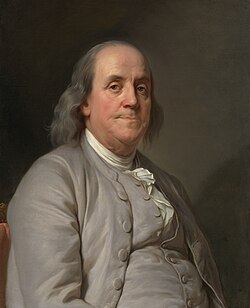
Worth reading
The Parable Against Persecution - Franklin's forged chapter of Genesis, written in King James English and passed off as scripture, in which Abraham drives out a stranger for not sharing his faith and God rebukes him. The real Franklin, against the 1934 forgery that runs under his name.
"The historical style of the Old Testament is here finely imitated; and the moral must strike every one who is not sunk in stupidity and superstition. Were it really a chapter of Genesis, one is apt to think, that persecution could never have shown a bare face among Jews or Christians. But alas! that is a vain thought. Such a passage in the Old Testament would avail as little against the rancorous passions of men, as the following passages in the New Testament, though persecution cannot be condemned in terms more explicit. _Him that is weak in the faith, receive you, but not to doubtful disputations. For, &c._" B. V.
The Complete Works in Philosophy, Politics and Morals of the late Dr. Benjamin Franklin, Vol. 2 [of 3]open the book ↗
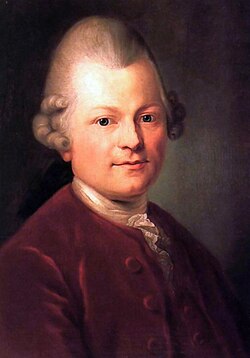
Gotthold Ephraim Lessing1729–1781writing
Both ways
"Aye, there peeps out the Jew, the ordinary Jew" - the dervish accounting for Nathan's generosity as a business in God's favour. Lessing writes the sneer so an audience will hear itself.
Aye, there peeps out the Jew, The ordinary Jew. Believe me, prince, He’s jealous, really envious of your giving. To earn God’s favour seems his very business. He lends not that he may always have to give. The law commandeth mercy, not compliance: And thus for mercy’s sake he’s uncomplying. ’Tis true, I am not now on the best terms With Nathan, but I must entreat you, think not That therefore I would do injustice to him. He’s good in everything, but not in that— Only in that. I’ll knock at other doors. I just have recollected an old Moor, Who’s rich and covetous—I go—I go.
Nathan the Wise; a dramatic poem in five actsopen the book ↗
Worth reading
Nathan alone, working out what the Sultan wants: truth, offered like coin, to be flung down and told upon the counter. The wisest speech in the play and it belongs to the Jew.
Strange! how is this? what wills the sultan of me? I came prepared with cash—he asks truth. Truth? As if truth too were cash—a coin disused That goes by weight—indeed ’tis some such thing— But a new coin, known by the stamp at once, To be flung down and told upon the counter, It is not that. Like gold in bags tied up, So truth lies hoarded in the wise man’s head To be brought out.—Which now in this transaction Which of us plays the Jew; he asks for truth, Is truth what he requires, his aim, his end? That this is but the glue to lime a snare Ought not to be suspected, ’twere too little, Yet what is found too little for the great— In fact, through hedge and pale to stalk at once Into one’s field beseems not—friends look round, Seek for the path, ask leave to pass the gate— I must be cautious. Yet to damp him back, And be the stubborn Jew is not the thing; And wholly to throw off the Jew, still less. For if no Jew he might with right inquire— Why not a Mussulman—Yes—that may serve me. Not children only can be quieted With stories. Ha! he comes—well, let him come.
Nathan the Wise; a dramatic poem in five actsopen the book ↗
Worth reading
The line belongs to the Patriarch, and Lessing wrote the play so that an audience would hear how a churchman sounds when he says it. Nathan was written for Moses Mendelssohn, Lessing's friend.
The Jew has still deserved the faggot—for ’Twere better it here died in misery Than for eternal woe to live. Besides, Why should the Jew forestall the hand of God? God, if he wills to save, can save without him.
TEMPLAR.
And spite of him too save eternally.
PATRIARCH.
That’s nothing! Still the Jew is to be burnt.
TEMPLAR.
That hurts me—more particularly as ’Tis said he has not so much taught the maid His faith, as brought her up with the mere knowledge Of what our reason teaches about God.
Burke on the conquest of Canaan: the first settling of the Jews there attended by an almost entire extirpation of the former inhabitants. He is building an argument about population and slaughter, and reaches for this.
This spot happened, it matters not here by what means, to become at several times extremely populous, and to supply men for slaughters scarcely credible, if other well-known and well-attested ones had not given them a color. The first settling of the Jews here was attended by an almost entire extirpation of all the former inhabitants. Their own civil wars, and those with their petty neighbors, consumed vast multitudes almost every year for several centuries; and the irruptions of the kings of Babylon and Assyria made immense ravages. Yet we have their history but partially, in an indistinct, confused manner; so that I shall only throw the strong point of light upon that part which coincides with Roman history, and of that part only on the point of time when they received the great and final stroke which made them, no more a nation; a stroke which is allowed to have cut off little less than two millions of that people. I say nothing of the loppings made from that stock whilst it stood; nor from the suckers that grew out of the old root ever since. But if, in this inconsiderable part of the globe, such a carnage has been made in two or three short reigns, and that this great carnage, great as it is, makes but a minute part of what the histories of that people inform us they suffered; what shall we judge of countries more extended, and which have waged wars by far more considerable?
The Works of the Right Honourable Edmund Burke, Vol. 01 (of 12)open the book ↗
Avoid
Reflections on the Revolution in France. Lord George Gordon converted to Judaism, and Burke sends him to meditate on his Talmud and buy his freedom with the old hoards of the synagogue and the compound interest on the thirty pieces of silver.
… Let him there meditate on his Talmud, until he learns a conduct more becoming his birth and parts, and not so disgraceful to the ancient religion to which he has become a proselyte,--or until some persons from your side of the water, to please your new Hebrew brethren, shall ransom him. He may then be enabled to purchase, with the old hoards of the synagogue, and a very small poundage on the long compound interest of the thirty pieces of silver, (Dr. Price has shown us what miracles compound interest will perform in 1790 years,) the lands which are lately discovered to have been usurped by the Gallican Church. …
In England, we give no credit to them. We are generous enemies; we are faithful allies. We spurn from us with disgust and indignation the slanders of those who bring us their anecdotes with the attestation of the flower-de-luce on their shoulder. We have Lord George Gordon fast in Newgate; and neither his being a public proselyte to Judaism, nor his having, in his zeal against Catholic priests and all sorts of ecclesiastics, raised a mob (excuse the term, it is still in use here) which pulled down all our prisons, have preserved to him a liberty of which he did not render himself worthy by a virtuous use of it. We have rebuilt Newgate, and tenanted the mansion. We have prisons almost as strong as the Bastile, for those who dare to libel the queens of France. In this spiritual retreat let the noble libeller remain. Let him there meditate on his Talmud, until he learns a conduct more becoming his birth and parts, and not so disgraceful to the ancient religion to which he has become a proselyte,--or until some persons from your side of the water, to please your new Hebrew brethren, shall ransom him. He may then be enabled to purchase, with the old hoards of the synagogue, and a very small poundage on the long compound interest of the thirty pieces of silver, (Dr. Price has shown us what miracles compound interest will perform in 1790 years,) the lands which are lately discovered to have been usurped by the Gallican Church. Send us your Popish Archbishop of Paris, and we will send you our Protestant Rabbin. We shall treat the person you send us in exchange like a gentleman and an honest man, as he is: but pray let him bring with him the fund of his hospitality, bounty, and charity; and, depend upon it, we shall never confiscate a shilling of that honorable and pious fund, nor think of enriching the Treasury with the spoils of the poor-box.
The Works of the Right Honourable Edmund Burke, Vol. 03 (of 12)open the book ↗
Edward Gibbon1737–1794history
Both ways
Gibbon is cool about everyone, and the coolness cuts both ways here: the attachment to the Mosaic law that the ancient world found ridiculous is the thing he finds remarkable.
This inflexible perseverance, which appeared so odious or so ridiculous to the ancient world, assumes a more awful character, since Providence has deigned to reveal to us the mysterious history of the chosen people. But the devout and even scrupulous attachment to the Mosaic religion, so conspicuous among the Jews who lived under the second temple, becomes still more surprising, if it is compared with the stubborn incredulity of their forefathers. When the law was given in thunder from Mount Sinai, when the tides of the ocean and the course of the planets were suspended for the convenience of the Israelites, and when temporal rewards and punishments were the immediate consequences of their piety or disobedience, they perpetually relapsed into rebellion against the visible majesty of their Divine King, placed the idols of the nations in the sanctuary of Jehovah, and imitated every fantastic ceremony that was practised in the tents of the Arabs, or in the cities of Phœnicia. 9 As the protection of Heaven was deservedly withdrawn from the ungrateful race, their faith acquired a proportionable degree of vigor and purity.
"A single people refused to join in the common intercourse of mankind." Gibbon states the charge of separateness as the historical fact it was taken for, and the rest of the chapter builds on it.
… 3 Neither the violence of Antiochus, nor the arts of Herod, nor the example of the circumjacent nations, could ever persuade the Jews to associate with the institutions of Moses the elegant mythology of the Greeks. 4 According to the maxims of universal toleration, the Romans protected a superstition which they despised. …
I. We have already described the religious harmony of the ancient world, and the facility with which the most different and even hostile nations embraced, or at least respected, each other’s superstitions. A single people refused to join in the common intercourse of mankind. The Jews, who, under the Assyrian and Persian monarchies, had languished for many ages the most despised portion of their slaves, 1 emerged from obscurity under the successors of Alexander; and as they multiplied to a surprising degree in the East, and afterwards in the West, they soon excited the curiosity and wonder of other nations. 2 The sullen obstinacy with which they maintained their peculiar rites and unsocial manners seemed to mark them out as a distinct species of men, who boldly professed, or who faintly disguised, their implacable habits to the rest of human kind. 3 Neither the violence of Antiochus, nor the arts of Herod, nor the example of the circumjacent nations, could ever persuade the Jews to associate with the institutions of Moses the elegant mythology of the Greeks. 4 According to the maxims of universal toleration, the Romans protected a superstition which they despised. 5 The polite Augustus condescended to give orders, that sacrifices should be offered for his prosperity in the temple of Jerusalem; 6 whilst the meanest of the posterity of Abraham, who should have paid the same homage to the Jupiter of the Capitol, would have been an object of abhorrence to himself and to his brethren.
The History of the Decline and Fall of the Roman Empire: Table of Contents with links in the HTML file to the two Project Gutenberg editions (12 volumes)open the book ↗
Both ways
The miracles beheld with careless indifference, and then the belief in them preserving the Jews from idolatry under every calamity. Gibbon finds the sequence contradictory and says so.
The contemporaries of Moses and Joshua had beheld with careless indifference the most amazing miracles. Under the pressure of every calamity, the belief of those miracles has preserved the Jews of a later period from the universal contagion of idolatry; and in contradiction to every known principle of the human mind, that singular people seems to have yielded a stronger and more ready assent to the traditions of their remote ancestors, than to the evidence of their own senses. 10
The History of the Decline and Fall of the Roman Empireopen the book ↗
Both ways
"The Jewish religion was admirably fitted for defence, but it was never designed for conquest." The whole of chapter fifteen turns on that sentence.
The Jewish religion was admirably fitted for defence, but it was never designed for conquest; and it seems probable that the number of proselytes was never much superior to that of apostates. The divine promises were originally made, and the distinguishing rite of circumcision was enjoined, to a single family. When the posterity of Abraham had multiplied like the sands of the sea, the Deity, from whose mouth they received a system of laws and ceremonies, declared himself the proper and as it were the national God of Israel; and with the most jealous care separated his favorite people from the rest of mankind. The conquest of the land of Canaan was accompanied with so many wonderful and with so many bloody circumstances, that the victorious Jews were left in a state of irreconcilable hostility with all their neighbors. They had been commanded to extirpate some of the most idolatrous tribes, and the execution of the divine will had seldom been retarded by the weakness of humanity.
The History of the Decline and Fall of the Roman Empireopen the book ↗
Avoid
The prohibition of marriage and alliance with other nations, to the third, the seventh, the tenth generation - Gibbon's evidence for the charge of separateness.
With the other nations they were forbidden to contract any marriages or alliances; and the prohibition of receiving them into the congregation, which in some cases was perpetual, almost always extended to the third, to the seventh, or even to the tenth generation. The obligation of preaching to the Gentiles the faith of Moses had never been inculcated as a precept of the law, nor were the Jews inclined to impose it on themselves as a voluntary duty.
The History of the Decline and Fall of the Roman Empireopen the book ↗
Avoid
"That unsocial people", actuated by the selfish vanity of the Greeks rather than the generous policy of Rome - Gibbon explaining why the Jews did not proselytise.
In the admission of new citizens that unsocial people was actuated by the selfish vanity of the Greeks, rather than by the generous policy of Rome. The descendants of Abraham were flattered by the opinion that they alone were the heirs of the covenant, and they were apprehensive of diminishing the value of their inheritance by sharing it too easily with the strangers of the earth. A larger acquaintance with mankind extended their knowledge without correcting their prejudices; and whenever the God of Israel acquired any new votaries, he was much more indebted to the inconstant humor of polytheism than to the active zeal of his own missionaries. 11 The religion of Moses seems to be instituted for a particular country as well as for a single nation; and if a strict obedience had been paid to the order, that every male, three times in the year, should present himself before the Lord Jehovah, it would have been impossible that the Jews could ever have spread themselves beyond the narrow limits of the promised land. 12 That obstacle was indeed removed by the destruction of the temple of Jerusalem; but the most considerable part of the Jewish religion was involved in its destruction; and the Pagans, who had long wondered at the strange report of an empty sanctuary, 13 were at a loss to discover what could be the object, or what could be the instruments, of a worship which was destitute of temples and of altars, of priests and of sacrifices.
The History of the Decline and Fall of the Roman Empireopen the book ↗
Avoid
Even in their fallen state, asserting lofty and exclusive privileges, and keeping distinctions of days and meats that he calls trivial though burdensome.
Yet even in their fallen state, the Jews, still asserting their lofty and exclusive privileges, shunned, instead of courting, the society of strangers. They still insisted with inflexible rigor on those parts of the law which it was in their power to practise. Their peculiar distinctions of days, of meats, and a variety of trivial though burdensome observances, were so many objects of disgust and aversion for the other nations, to whose habits and prejudices they were diametrically opposite. The painful and even dangerous rite of circumcision was alone capable of repelling a willing proselyte from the door of the synagogue. 14
The History of the Decline and Fall of the Roman Empireopen the book ↗
Both ways
The church enfranchised from the bonds of the synagogue - the Jewish converts who kept their fathers' ceremonies and would not let them go.
The enfranchisement of the church from the bonds of the synagogue was a work, however, of some time and of some difficulty. The Jewish converts, who acknowledged Jesus in the character of the Messiah foretold by their ancient oracles, respected him as a prophetic teacher of virtue and religion; but they obstinately adhered to the ceremonies of their ancestors, and were desirous of imposing them on the Gentiles, who continually augmented the number of believers. These Judaizing Christians seem to have argued with some degree of plausibility from the divine origin of the Mosaic law, and from the immutable perfections of its great Author. They affirmed, that if the Being, who is the same through all eternity, had designed to abolish those sacred rites which had served to distinguish his chosen people, the repeal of them would have been no less clear and solemn than their first promulgation: that, instead of those frequent declarations, which either suppose or assert the perpetuity of the Mosaic religion, it would have been represented as a provisionary scheme intended to last only to the coming of the Messiah, who should instruct mankind in a more perfect mode of faith and of worship: 15 that the Messiah himself, and his disciples who conversed with him on earth, instead of authorizing by their example the most minute observances of the Mosaic law, 16 would have published to the world the abolition of those useless and obsolete ceremonies, without suffering Christianity to remain during so many years obscurely confounded among the sects of the Jewish church. Arguments like these appear to have been used in the defence of the expiring cause of the Mosaic law; but the industry of our learned divines has abundantly explained the ambiguous language of the Old Testament, and the ambiguous conduct of the apostolic teachers. It was proper gradually to unfold the system of the gospel, and to pronounce, with the utmost caution and tenderness, a sentence of condemnation so repugnant to the inclination and prejudices of the believing Jews.
The History of the Decline and Fall of the Roman Empireopen the book ↗
Thomas Paine1737–1809politics
Avoid
Paine's Jesus, who preached against the corruptions and avarice of the Jewish priests and was killed for it. The deicide charge arriving by way of the Enlightenment rather than the Church.
That such a person as Jesus Christ existed, and that he was crucified, which was the mode of execution at that day, are historical relations strictly within the limits of probability. He preached most excellent morality, and the equality of man; but he preached also against the corruptions and avarice of the Jewish priests, and this brought upon him the hatred and vengeance of the whole order of priest-hood. The accusation which those priests brought against him was that of sedition and conspiracy against the Roman government, to which the Jews were then subject and tributary; and it is not improbable that the Roman government might have some secret apprehension of the effects of his doctrine as well as the Jewish priests; neither is it improbable that Jesus Christ had in contemplation the delivery of the Jewish nation from the bondage of the Romans. Between the two, however, this virtuous reformer and revolutionist lost his life. [NOTE: The French work has here: “However this may be, for one or the other of these suppositions this virtuous reformer, this revolutionist, too little imitated, too much forgotten, too much misunderstood, lost his life.”—Editor. (Conway)]
The Writings of Thomas Paine — Volume 4 (1794-1796): The Age of Reasonopen the book ↗
Avoid
Paine was arguing against revealed religion and reached for the Jews to do it, crediting them with the cruelty and revenge he found in the scripture he was attacking.
We know nothing of what the ancient Gentile world (as it is called) was before the time of the Jews, whose practice has been to calumniate and blacken the character of all other nations; and it is from the Jewish accounts that we have learned to call them heathens. But, as far as we know to the contrary, they were a just and moral people, and not addicted, like the Jews, to cruelty and revenge, but of whose profession of faith we are unacquainted. It appears to have been their custom to personify both virtue and vice by statues and images, as is done now-a-days both by statuary and by painting; but it does not follow from this that they worshipped them any more than we do.—I pass on to the book of,
Schiller on the Inquisition: invented to clear Granada of the feeble remnant of Saracens and Jews, and then turned on everyone else.
But the Inquisition which we are here speaking of came from the west of Europe, and was of a different origin and form. The last Moorish throne in Granada had fallen in the fifteenth century, and the false faith of the Saracens had finally succumbed before the fortunes of Christianity. But the gospel was still new, and but imperfectly established in this youngest of Christian kingdoms, and in the confused mixture of heterogeneous laws and manners the religions had become mixed. It is true the sword of persecution had driven many thousand families to Africa, but a far larger portion, detained by the love of climate and home, purchased remission from this dreadful necessity by a show of conversion, and continued at Christian altars to serve Mohammed and Moses. So long as prayers were offered towards Mecca, Granada was not subdued; so long as the new Christian, in the retirement of his house, became again a Jew or a Moslem, he was as little secured to the throne as to the Romish See. It was no longer deemed sufficient to compel a perverse people to adopt the exterior forms of a new faith, or to wed it to the victorious church by the weak bands of ceremonials; the object now was to extirpate the roots of an old religion, and to subdue an obstinate bias which, by the slow operation of centuries, had been implanted in their manners, their language, and their laws, and by the enduring influence of a paternal soil and sky was still maintained in its full extent and vigor.
The Virginia Statute for Religious Freedom, and the proof that its protection of opinion was meant to be universal: the attempt to confine it to Christianity was voted down, so that it covered the Jew and the Mahometan too.
The bill for establishing religious freedom, the principles of which had, to a certain degree, been enacted before, I had drawn in all the latitude of reason and right. It still met with opposition; but, with some mutilations in the preamble, it was finally passed; and a singular proposition proved that its protection of opinion was meant to be universal. Where the preamble declares, that coercion is a departure from the plan of the holy author of our religion, an amendment was proposed, by inserting the word "Jesus Christ," so that it should read, "a departure from the plan of Jesus Christ, the holy author of our religion;" the insertion was rejected by a great majority, in proof that they meant to comprehend, within the mantle of its protection, the Jew and the Gentile, the Christian and Mahometan, the Hindoo, and Infidel of every denomination.
The Writings of Thomas Jefferson, Vol. 1 (of 9): Being His Autobiography, Correspondence, Reports, Messages, Addresses, and Other Writings, Official and Privateopen the book ↗
Both ways
Jefferson on Adair's theory that the American Indians descended from the Jews - the kind of thing an enlightened man of his day tested rather than believed.
Adair too had his kink. He believed all the Indians of America to be descended from the Jews; the same laws, usages, rites and ceremonies, the same sacrifices, priests, prophets, fasts and festivals, almost the same religion, and that they all spoke Hebrew. For, although he writes particularly of the Southern Indians only, the Catawbas, Creeks, Cherokees, Chickasaws and Chocktaws, with whom alone he was personally acquainted, yet he generalizes whatever he found among them, and brings himself to believe that the hundred languages of America, differing fundamentally every one from every other, as much as Greek from Gothic, yet have all one common prototype. He was a trader, a man of learning, a self-taught Hebraist, a strong religionist, and of as sound a mind as Don Quixotte in whatever did not touch his religious chivalry. His book contains a great deal of real instruction on its subject, only requiring the reader to be constantly on his guard against the wonderful obliquities of his theory.
The Writings of Thomas Jefferson, Vol. 6 (of 9): Being His Autobiography, Correspondence, Reports, Messages, Addresses, and Other Writings, Official and Privateopen the book ↗
Both ways
Jefferson on the two tables as the evidence of the covenant by which the Almighty attached the people of Israel to himself, reading Exodus like a lawyer reading a deed.
I know not whether Goethen translated or abridged from the Hebrew, or whether he used any translation, Greek, Latin, or German. But he differs in form and words somewhat from our version, Exodus 34: 10 to 28. The sense seems to be the same. The tables were the evidence of the covenant, by which the Almighty attached the people of Israel to himself. By these laws they were separated from all other nations, and were reminded of the principal epochs of their history.
The Writings of Thomas Jefferson, Vol. 6 (of 9): Being His Autobiography, Correspondence, Reports, Messages, Addresses, and Other Writings, Official and Privateopen the book ↗
XIX century
Walter Scott1771–1832writing
Worth reading
Isaac of York at Cedric's hall, admitted as "this son of a rejected people" while the master of the house is too deep in a conversation about hounds to make anyone civil to him.
Probably the same motives which induced Cedric to open his hall to this son of a rejected people, would have made him insist on his attendants receiving Isaac with more courtesy. But the Abbot had, at this moment, engaged him in a most interesting discussion on the breed and character of his favourite hounds, which he would not have interrupted for matters of much greater importance than that of a Jew going to bed supperless. While Isaac thus stood an outcast in the present society, like his people among the nations, looking in vain for welcome or resting place, the pilgrim who sat by the chimney took compassion upon him, and resigned his seat, saying briefly, “Old man, my garments are dried, my hunger is appeased, thou art both wet and fasting.” So saying, he gathered together, and brought to a flame, the decaying brands which lay scattered on the ample hearth; took from the larger board a mess of pottage and seethed kid, placed it upon the small table at which he had himself supped, and, without waiting the Jew’s thanks, went to the other side of the hall;—whether from unwillingness to hold more close communication with the object of his benevolence, or from a wish to draw near to the upper end of the table, seemed uncertain.
Scott stops the romance to explain to his readers what was actually done to the Jews of medieval England, in a novel published eleven years before Parliament first debated letting Jews hold office.
His doubts might have been indeed pardoned; for, except perhaps the flying fish, there was no race existing on the earth, in the air, or the waters, who were the object of such an unintermitting, general, and relentless persecution as the Jews of this period. Upon the slightest and most unreasonable pretences, as well as upon accusations the most absurd and groundless, their persons and property were exposed to every turn of popular fury; for Norman, Saxon, Dane, and Briton, however adverse these races were to each other, contended which should look with greatest detestation upon a people, whom it was accounted a point of religion to hate, to revile, to despise, to plunder, and to persecute. The kings of the Norman race, and the independent nobles, who followed their example in all acts of tyranny, maintained against this devoted people a persecution of a more regular, calculated, and self-interested kind. It is a well-known story of King John, that he confined a wealthy Jew in one of the royal castles, and daily caused one of his teeth to be torn out, until, when the jaw of the unhappy Israelite was half disfurnished, he consented to pay a large sum, which it was the tyrant’s object to extort from him. The little ready money which was in the country was chiefly in possession of this persecuted people, and the nobility hesitated not to follow the example of their sovereign, in wringing it from them by every species of oppression, and even personal torture. Yet the passive courage inspired by the love of gain, induced the Jews to dare the various evils to which they were subjected, in consideration of the immense profits which they were enabled to realize in a country naturally so wealthy as England. In spite of every kind of discouragement, and even of the special court of taxations already mentioned, called the Jews’ Exchequer, erected for the very purpose of despoiling and distressing them, the Jews increased, multiplied, and accumulated huge sums, which they transferred from one hand to another by means of bills of exchange—an invention for which commerce is said to be indebted to them, and which enabled them to transfer their wealth from land to land, that when threatened with oppression in one country, their treasure might be secured in another.
Scott setting the obstinacy and avarice of the Jews against the fanaticism and tyranny of those they lived under, and making the wealth both the danger and the shield.
… to the fanaticism that tyranny of those under whom they lived, seemed to increase in proportion to the persecution with which they were visited; and the immense wealth they usually acquired in commerce, while it frequently placed them in danger, was at other times used to extend their influence, and to secure to them a certain degree of protection. On these terms they lived; and their character, influenced accordingly, was watchful, suspicious, and timid—yet obstinate, uncomplying, and skilful in evading the dangers to which they were exposed.
The obstinacy and avarice of the Jews being thus in a measure placed in opposition to the fanaticism that tyranny of those under whom they lived, seemed to increase in proportion to the persecution with which they were visited; and the immense wealth they usually acquired in commerce, while it frequently placed them in danger, was at other times used to extend their influence, and to secure to them a certain degree of protection. On these terms they lived; and their character, influenced accordingly, was watchful, suspicious, and timid—yet obstinate, uncomplying, and skilful in evading the dangers to which they were exposed.
The Palmer to Isaac: to protect a Jew against a Saracen can scarce be accounted unworthy of a Christian. The grudge is in the sentence and so is the protection.
“Money and recompense,” said the Palmer, interrupting him, “I have already said I require not of thee. Guide thee I can; and, it may be, even in some sort defend thee; since to protect a Jew against a Saracen, can scarce be accounted unworthy of a Christian. Therefore, Jew, I will see thee safe under some fitting escort. We are now not far from the town of Sheffield, where thou mayest easily find many of thy tribe with whom to take refuge.”
Rebecca the physician. The barons who despised the Jews put themselves in Jewish hands when they were wounded, and Scott says so plainly.
But the Jews, both male and female, possessed and practised the medical science in all its branches, and the monarchs and powerful barons of the time frequently committed themselves to the charge of some experienced sage among this despised people, when wounded or in sickness. The aid of the Jewish physicians was not the less eagerly sought after, though a general belief prevailed among the Christians, that the Jewish Rabbins were deeply acquainted with the occult sciences, and particularly with the cabalistical art, which had its name and origin in the studies of the sages of Israel. Neither did the Rabbins disown such acquaintance with supernatural arts, which added nothing (for what could add aught?) to the hatred with which their nation was regarded, while it diminished the contempt with which that malevolence was mingled. A Jewish magician might be the subject of equal abhorrence with a Jewish usurer, but he could not be equally despised. It is besides probable, considering the wonderful cures they are said to have performed, that the Jews possessed some secrets of the healing art peculiar to themselves, and which, with the exclusive spirit arising out of their condition, they took great care to conceal from the Christians amongst whom they dwelt.
The most candid thing on this page. Lamb admits the prejudice, names what holds it — Hugh of Lincoln, the 1255 blood libel — and declines to put it down. He is not arguing a case; he is describing the machinery from inside it.
I have, in the abstract, no disrespect for Jews. They are a piece of stubborn antiquity, compared with which Stonehenge is in its nonage. They date beyond the pyramids. But I should not care to be in habits of familiar intercourse with any of that nation. I confess that I have not the nerves to enter their synagogues. Old prejudices cling about me. I cannot shake off the story of Hugh of Lincoln. Centuries of injury, contempt, and hate, on the one side,--of cloaked revenge, dissimulation, and hate, on the other, between our and their fathers, must, and ought, to affect the blood of the children. I cannot believe it can run clear and kindly yet; or that a few fine words, such as candour, liberality, the light of a nineteenth century, can close up the breaches of so deadly a disunion. A Hebrew is nowhere congenial to me. He is least distasteful on 'Change--for the mercantile spirit levels all distinctions, as all are beauties in the dark. I boldly confess that I do not relish the approximation of Jew and Christian, which has become so fashionable. The reciprocal endearments have, to me, something hypocritical and unnatural in them. I do not like to see the Church and Synagogue kissing and congeeing in awkward postures of an affected civility. If they are converted, why do they not come over to us altogether? Why keep up a form of separation, when the life of it is fled? If they can sit with us at table, why do they keck at our cookery? I do not understand these half convertites. Jews christianizing--Christians judaizing--puzzle me. I like fish or flesh. A moderate Jew is a more confounding piece of anomaly than a wet Quaker. The spirit of the synagogue is essentially separative. B---- would have been more in keeping if he had abided by the faith of his forefathers. There is a fine scorn in his face, which nature meant to be of ---- Christians. The Hebrew spirit is strong in him, in spite of his proselytism. He cannot conquer the Shibboleth. How it breaks out, when he sings, "The Children of Israel passed through the Red Sea!" The auditors, for the moment, are as Egyptians to him, and he rides over our necks in triumph. There is no mistaking him.--B---- has a strong expression of sense in his countenance, and it is confirmed by his singing. The foundation of his vocal excellence is sense. He sings with understanding, as Kemble delivered dialogue. He would sing the Commandments, and give an appropriate character to each prohibition. His nation, in general, have not ever-sensible countenances. How should they?--but you seldom see a silly expression among them. Gain, and the pursuit of gain, sharpen a man's visage. I never heard of an idiot being born among them.--Some admire the Jewish female physiognomy. I admire it--but with trembling. Jael had those full dark inscrutable eyes.
A Jewish woman in America wrote to Edgeworth about the Jews in her earlier books, and she answered with a whole novel. It opens with a maid frightening a six-year-old with a Jewish pedlar — her anatomy of exactly how the thing is installed in a child. Dickens did the same thing for Eliza Davis forty-seven years later.
I could not understand the words he said, but as he looked up at our balcony he saw me--smiled--and I remember thinking that he had a good-natured countenance. The maid nodded to him; he stood still, and at the same instant she seized upon me, exclaiming, “Time for you to come off to bed, Master Harrington.” I resisted, and, clinging to the rails, began kicking and roaring. “If you don’t come quietly this minute, Master Harrington,” said she, “I’ll call to Simon the Jew there,” pointing to him, “and he shall come up and carry you away in his great bag.” The old man’s eyes were upon me; and to my fancy the look of his eyes and his whole face had changed in an instant. I was struck with terror--my hands let go their grasp--and I suffered myself to be carried off as quietly as my maid could desire. She hurried and huddled me into bed, bid me go to sleep, and ran down stairs. To sleep I could not go, but full of fear and curiosity I lay, pondering on the thoughts of Simon the Jew and his bag, who had come to carry me away in the height of
He built a whole hierarchy on it: the Old Testament as law without redemption, which for him made Judaism the shallowest of the religions he ranked.
The contrast which the New Testament presents when compared with the Old, according to the ecclesiastical view of the matter, is just that existing between my ethical system and the moral philosophy of Europe. The Old Testament represents man as under the dominion of Law, in which, however, there is no redemption. The New Testament declares Law to have failed, frees man from its dominion, and in its stead preaches the kingdom of grace, to be won by faith, love of neighbor and entire sacrifice of self. This is the path of redemption from the evil of the world. The spirit of the New Testament is undoubtedly asceticism, however your protestants and rationalists may twist it to suit their purpose. Asceticism is the denial of the will to live; and the transition from the Old Testament to the New, from the dominion of Law to that of Faith, from justification by works to redemption through the Mediator, from the domain of sin and death to eternal life in Christ, means, when taken in its real sense, the transition from the merely moral virtues to the denial of the will to live. My philosophy shows the metaphysical foundation of justice and the love of mankind, and points to the goal to which these virtues necessarily lead, if they are practised in perfection. At the same time it is candid in confessing that a man must turn his back upon the world, and that the denial of the will to live is the way of redemption. It is therefore really at one with the spirit of the New Testament, whilst all other systems are couched in the spirit of the Old; that is to say, theoretically as well as practically, their result is Judaism--mere despotic theism. In this sense, then, my doctrine might be called the only true Christian philosophy--however paradoxical a statement this may seem to people who take superficial views instead of penetrating to the heart of the matter.
Elie Magus in Cousin Pons - the old Jew buying house property against Hebrew law and custom, as miserly as the late lamented Gobseck. Balzac built two of them and gave the second the first's vices.
You may be quite sure that the old Jew had sound reasons for buying house property, contrary to the Hebrew law and custom. He had ended, as most of us end, with a hobby that bordered on a craze. He was as miserly as his friend, the late lamented Gobseck; but he had been caught by the snare of the eyes, by the beauty of the pictures in which he dealt. As his taste grew more and more fastidious, it became one of the passions which princes alone can indulge when they are wealthy and art-lovers. As the second King of Prussia found nothing that so kindled enthusiasm as the spectacle of a grenadier over six feet high, and gave extravagant sums for a new specimen to add to his living museum of a regiment, so the retired picture-dealer was roused to passion-pitch only by some canvas in perfect preservation, untouched since the master laid down the brush; and what was more, it must be a picture of the painter’s best time. No great sales, therefore, took place but Elie Magus was there; every mart knew him; he traveled all over Europe. The ice-cold, money-worshiping soul in him kindled at the sight of a perfect work of art, precisely as a libertine, weary of fair women, is roused from apathy by the sight of a beautiful girl, and sets out afresh upon the quest of flawless loveliness. A Don Juan among fair works of art, a worshiper of the Ideal, Elie Magus had discovered joys that transcend the pleasure of a miser gloating over his gold--he lived in a seraglio of great paintings.
"Rome was eaten up by the same Judaic spiritualism" - Heine on the empire's death agony. He is on this page twice and on both sides, which is the only honest way to have him.
… Did perhaps murdered Judea, by bequeathing its spiritualism to the Romans, seek to avenge itself on the victorious foe, as did the dying centaur, who so cunningly wheedled the son of Jupiter into wearing the deadly vestment poisoned with his own blood? In truth, Rome, the Hercules among nations, was so effectually consumed by the Judaic poison that helm and armour fell from its decaying limbs, and its imperious battle tones degenerated into the prayers of snivelling priests and the trilling of eunuchs.
Unfortunate excess! it robbed the Roman body-politic of its last energies. Rome was not destroyed by the division into two empires. On the Bosphorus as on the Tiber, Rome was eaten up by the same Judaic spiritualism, and in both Roman history became the record of a slow dying-away, a death agony that lasted for centuries. Did perhaps murdered Judea, by bequeathing its spiritualism to the Romans, seek to avenge itself on the victorious foe, as did the dying centaur, who so cunningly wheedled the son of Jupiter into wearing the deadly vestment poisoned with his own blood? In truth, Rome, the Hercules among nations, was so effectually consumed by the Judaic poison that helm and armour fell from its decaying limbs, and its imperious battle tones degenerated into the prayers of snivelling priests and the trilling of eunuchs.
Medieval sacred poetry relating exclusively to the Jewish people, "which alone was considered sacred" - Heine noticing what Christian Europe took and what it denied taking it from.
… The flower of the German sacred poetry of the middle ages is, perhaps, Barlaam and Josaphat, a poem in which the dogma of self-denial, of continence, of renunciation, of the scorn of all worldly pleasures, is most consistently expressed. Next in order of merit I would rank Lobgesang auf den Heiligen Anno, but the latter poem already evinces a marked tendency towards secular themes. It differs in general from the former somewhat as a Byzantine image of a saint differs from an old German representation. Just as in these Byzantine pictures, so also do we find in Barlaam and Josaphat the greatest simplicity; there is no perspective, and the long, lean, statue-like forms, and the grave, ideal countenances, stand severely outlined, as though in bold relief against a background of pale gold. …
Although the epic poetry of the middle ages was divided into sacred and secular, yet both classes were purely Christian in their nature; for if the sacred poetry related exclusively to the Jewish people and its history, which alone was considered sacred; if its themes were the heroes of the Old and the New Testaments, and their legends--in brief, the Church--still all the Christian views and aims of that period were mirrored in the secular poetry. The flower of the German sacred poetry of the middle ages is, perhaps, Barlaam and Josaphat, a poem in which the dogma of self-denial, of continence, of renunciation, of the scorn of all worldly pleasures, is most consistently expressed. Next in order of merit I would rank Lobgesang auf den Heiligen Anno, but the latter poem already evinces a marked tendency towards secular themes. It differs in general from the former somewhat as a Byzantine image of a saint differs from an old German representation. Just as in these Byzantine pictures, so also do we find in Barlaam and Josaphat the greatest simplicity; there is no perspective, and the long, lean, statue-like forms, and the grave, ideal countenances, stand severely outlined, as though in bold relief against a background of pale gold. In the Lobgesang auf den Heiligen Anno, as in the old German pictures, the accessories seem almost more prominent than the subject; and, notwithstanding the bold outlines, every detail is most minutely executed, and one knows not which to admire most, the giant-like conception or the dwarf-like patience of execution. Ottfried's Evangeliengedicht, which is generally praised as the masterpiece of this sacred poetry, is far inferior to both of these poems.
Heine was baptised at twenty-eight for a career he never got, and spent his last years taking it back. This is from the late Confessions: Moses as the greater artist, who worked in people rather than granite.
… But not, like the Egyptians, did he construct his works of art from bricks and granite, but he built human pyramids and carved human obelisks. He took a poor shepherd tribe and from it created a nation which should defy centuries; a great, an immortal, a consecrated race, a God-serving people, who to all other nations should be as a model and prototype: he created Israel.
I had not previously much admired the character of Moses, probably because the Hellenic spirit was predominant in me, and I could not pardon the lawgiver of the Jews for his hate of the plastic arts. I failed to perceive that Moses, notwithstanding his enmity to art, was nevertheless himself a great artist, and possessed the true artistic spirit. Only, this artistic spirit with him, as with his Egyptian countrymen, was applied to the colossal and the imperishable. But not, like the Egyptians, did he construct his works of art from bricks and granite, but he built human pyramids and carved human obelisks. He took a poor shepherd tribe and from it created a nation which should defy centuries; a great, an immortal, a consecrated race, a God-serving people, who to all other nations should be as a model and prototype: he created Israel.
"The Jews were clamorous for their money" - Macaulay reaching for the figure in passing, in the same collected works that hold his speech against the disabilities.
In the mean time the squire was pressed more and more for money. The parish could pay no more. The rector refused to lend a farthing. The Jews were clamorous for their money; and the landlord had no other resource than to call together the inhabitants of the parish, and to request their assistance. They now attacked him furiously about their grievances, and insisted that he should relinquish his oppressive powers. They insisted that his footmen should be kept in order, that the parson should pay his share of the rates, that the children of the parish should be allowed to fish in the trout-stream, and to gather blackberries in the {103}hedges. They at last went so far as to demand that he should acknowledge that he held his estate only in trust for them. His distress compelled him to submit. They, in return, agreed to set him free from his pecuniary difficulties, and to suffer him to inhabit the manor-house; and only annoyed him from time to time by singing impudent ballads under his window.
Critical, Historical, and Miscellaneous Essays; Vol. 1: With a Memoir and Indexopen the book ↗
Worth reading
The best answer anyone has given to the money libel, delivered in the House of Commons to get the Jewish disabilities off the English statute book. They never fail to plead in justification of persecution the vices which persecution has engendered — and then he itemises every one of them.
… Such, Sir, has in every age been the reasoning of bigots. They never fail to plead in justification of persecution the vices which persecution has engendered. England has been to the Jews less than half a country; and we revile them because they do not feel for England more than a half patriotism. We treat them as slaves, and wonder that they do not regard us as brethren. We drive them to mean occupations, and then reproach them for not embracing honourable professions. We long forbade them to possess land; and we complain that they chiefly occupy themselves in trade. …
Another charge has been brought against the Jews, not by my honourable friend the Member for the University of Oxford--he has too much learning and too much good feeling to make such a charge--but by the honourable Member for Oldham, who has, I am sorry to see, quitted his place. The honourable Member for Oldham tells us that the Jews are naturally a mean race, a sordid race, a money-getting race; that they are averse to all honourable callings; that they neither sow nor reap; that they have neither flocks nor herds; that usury is the only pursuit for which they are fit; that they are destitute of all elevated and amiable sentiments. Such, Sir, has in every age been the reasoning of bigots. They never fail to plead in justification of persecution the vices which persecution has engendered. England has been to the Jews less than half a country; and we revile them because they do not feel for England more than a half patriotism. We treat them as slaves, and wonder that they do not regard us as brethren. We drive them to mean occupations, and then reproach them for not embracing honourable professions. We long forbade them to possess land; and we complain that they chiefly occupy themselves in trade. We shut them out from all the paths of ambition; and then we despise them for taking refuge in avarice. During many ages we have, in all our dealings with them, abused our immense superiority of force; and then we are disgusted because they have recourse to that cunning which is the natural and universal defence of the weak against the violence of the strong. But were they always a mere money-changing, money-getting, money-hoarding race? Nobody knows better than my honourable friend the Member for the University of Oxford that there is nothing in their national character which unfits them for the highest duties of citizens. He knows that, in the infancy of civilisation, when our island was as savage as New Guinea, when letters and arts were still unknown to Athens, when scarcely a thatched hut stood on what was afterwards the site of Rome, this contemned people had their fenced cities and cedar palaces, their splendid Temple, their fleets of merchant ships, their schools of sacred learning, their great statesmen and soldiers, their natural philosophers, their historians and their poets. What nation ever contended more manfully against overwhelming odds for its independence and religion? What nation ever, in its last agonies, gave such signal proofs of what may be accomplished by a brave despair? And if, in the course of many centuries, the oppressed descendants of warriors and sages have degenerated from the qualities of their fathers, if, while excluded from the blessings of law, and bowed down under the yoke of slavery, they have contracted some of the vices of outlaws and of slaves, shall we consider this as matter of reproach to them? Shall we not rather consider it as matter of shame and remorse to ourselves? Let us do justice to them. Let us open to them the door of the House of Commons. Let us open to them every career in which ability and energy can be displayed. Till we have done this, let us not presume to say that there is no genius among the countrymen of Isaiah, no heroism among the descendants of the Maccabees.
Jewish Disabilities, a speech to the Commons, 17 April 1833open the book ↗
Grace Aguilar1816–1847writing
Worth reading
A Jewish novelist on the Jews of Spain before the expulsion, whose low and despised estate was probably their safeguard. She died at thirty-one and was the most widely read Jewish writer in English of her century.
In spite of the miserable condition of the people during the civil struggles, the wealth of Spain had not decreased. It was protected and increased by a class of people whose low and despised estate was, probably, their safeguard--these were the Jews, who for many centuries had, both publicly and secretly, resided in Spain. There were many classes of this people in the land, scattered alike over Castile, Leon, Arragon, Navarre, and also in the Moorish territories; some there were confined to the mystic learning and profound studies of the schools, whence they sent many deeply learned men to other countries, where their worth and wisdom gained them yet greater regard than they received in Spain: others were low and degraded in outward seeming, yet literally holding and guiding the financial and commercial interests of the kingdom;--whose position was of the lowest--scorned and hated by the very people who yet employed them, and exposed to insult from every class; the third, and by far the largest body of Spanish Jews, were those who, Israelites in secret, were so completely Catholic in seeming, that the court, the camp, the council, even the monasteries themselves, counted them amongst them. And this had been the case for years--we should say for centuries--and yet so inviolable was the faith pledged to each other, so awful the dangers around them, were even suspicion excited, that the fatal secret never transpired; offices of state, as well as distinctions of honor, were frequently conferred on men who, had their faith or race been suspected, would have been regarded as the scum of the earth, and sentenced to torture and death, for daring to pass for what they were not. At the period of which we write, the fatal enemy to the secret Jews of more modern times, known as the Holy Office, did not exist; but a secret and terrible tribunal there was, whose power and extent were unknown to the Sovereigns of the land.
A proclaimed Jewess and her Catholic guardians, kind and gentle and restrained, in the novel Aguilar wrote about the Inquisition.
Few words passed between Marie and her guardians; their manner was kind and gentle, but intercourse between rigid Catholics and a proclaimed Jewess, could not be other wise than restrained. From the time that reason returned, the Queen had not visited her, doing actual violence to her own inclinations from tire mistaken--but in that age and to her character natural--dread that the affection and interest she felt towards Marie personally, would lessen the sentiments of loathing and abhorrence with which it was her duty to regard her faith. Isabella had within herself all the qualifications of a martyr. Once impressed that it was a religious duty, she would do violence to her most cherished wishes, sacrifice her dearest desires, her best affections, resign her most eagerly pursued plans--not without suffering indeed, but, according to the mistaken tenets of her religion, the greater personal suffering, the more meritorious was the deed believed to be. This spirit would, had she lived in an age when the Catholic faith was the persecuted, not the persecutor, have led her a willing martyr to the stake; as it was, this same spirit led to the establishment of the Inquisition, and expulsion of the Jews--deeds so awful in their consequences, that the actual motive of the woman-heart which prompted them, is utterly forgotten, and herself condemned. We must indeed deplore the mistaken tenets that could obtain such influence--deplore that man could so pervert the service of a God of love, as to believe and inculcate that such things could be acceptable to Him; but we should pause, and ask, if we ourselves had been influenced by such teaching, could we break from it? ere we condemn.
Carlyle in his own voice, retelling a twelfth-century abbey chronicle for a Victorian readership and reaching, unprompted, for the horseleech. The book was a landmark of social criticism and this passage travelled with it.
His one worldly care was to raise ready money; sufficient for the day is the evil thereof. And how he raised it: From usurious insatiable Jews; every fresh Jew sticking on him like a fresh horseleech, sucking his and our life out; crying continually, Give, give! Take one example instead of scores. Our Camera having fallen into ruin, William the Sacristan received charge to repair it; strict charge, but no money; Abbot Hugo would, and indeed could, give him no fraction of money. The Camera in ruins, and Hugo penniless and inaccessible, Willelmus Sacrista borrowed Forty Marcs (some Seven-and-twenty Pounds) of Benedict the Jew, and patched-up our Camera again. But the means of repaying him? There were no means. Hardly could Sacrista, Cellerarius, or any public officer, get ends to meet, on the indispensablest scale, with their shrunk allowances: ready money had vanished.
"One almost hopes he was one of those beleaguered Jews who hanged" - Carlyle wishing death on the abbey's creditor, in the book that made his name as a social critic.
Neither yet is this insatiable Jew satisfied or settled with: he had papers against us of 'small debts fourteen years old;' his modest claim amounts finally to 'Twelve hundred pounds besides interest;'--and one hopes he never got satisfied in this world; one almost hopes he was one of those beleaguered Jews who hanged themselves in York Castle shortly afterwards, and had his usances and quittances and horseleech papers summarily set fire to! For approximate justice will strive to accomplish itself; if not in one way, then in another. Jews, and also Christians and Heathens, who accumulate in this manner, though furnished with never so many parchments, do, at times, 'get their grinder-teeth successively pulled out of their head, each day a new grinder,' till they consent to disgorge again. A sad fact,--worth reflecting on.
"The Philistines were upon him, - that is to say, the Hebrews." The joke is the whole sentence.
… Thomas a Becket, though in a circuitous way, had brought deliverance! Neither Jew usurers, nor grumbling monks, nor other importunate despicability of men or mud-elements afflicted Abbot Hugo any more; but he dropt his rosaries, closed his account-books, closed his old eyes, and lay down into the long sleep. Heavy-laden hoary old Dominus Hugo, fare thee well.
In very truth, what could poor old Abbot Hugo do? A frail old man, and the Philistines were upon him,--that is to say, the Hebrews. He had nothing for it but to shrink away from them; get back into his warm flannels, into his warm delusions again. Happily, before it was quite too late, he bethought him of pilgriming to St. Thomas of Canterbury. He set out, with a fit train, in the autumn days of the year 1180; near Rochester City, his mule threw him, dislocated his poor kneepan, raised incurable inflammatory fever; and the poor old man got his dismissal from the whole coil at once. St. Thomas a Becket, though in a circuitous way, had brought deliverance! Neither Jew usurers, nor grumbling monks, nor other importunate despicability of men or mud-elements afflicted Abbot Hugo any more; but he dropt his rosaries, closed his account-books, closed his old eyes, and lay down into the long sleep. Heavy-laden hoary old Dominus Hugo, fare thee well.
"Jew harpies and unclean creatures our purveyors." Three sentences from three different pages of one book, which is why he is here three times.
Abbot Samson had found a Convent all in dilapidation; rain beating through it, material rain and metaphorical, from all quarters of the compass. Willelmus Sacrista sits drinking nightly, and doing mere tacenda. Our larders are reduced to leanness, Jew harpies and unclean creatures our purveyors; in our basket is no bread. Old women with their distaffs rush out on a distressed Cellarer in shrill Chartism. 'You cannot stir abroad but Jews and Christians pounce upon you with unsettled bonds;' debts boundless seemingly as the National Debt of England. For four years our new Lord Abbot never went abroad but Jew creditors and Christian, and all manner of creditors, were about him; driving him to very despair. Our Prior is remiss; our Cellarers, officials are remiss; our monks are remiss: what man is not remiss? Front this, Samson, thou alone art there to front it; it is thy task to front and fight this, and to die or kill it. May the Lord have mercy on thee!
Riah explains how he came to be the face of a Christian's usury, and what it cost every other Jew. Dickens wrote him after Eliza Davis wrote to him about Fagin, and Riah is the answer.
‘It looked so bad, Jenny,’ responded the old man, with gravity, ‘that I will straightway tell you what an impression it wrought upon me. I was hateful in mine own eyes. I was hateful to myself, in being so hateful to the debtor and to you. But more than that, and worse than that, and to pass out far and broad beyond myself—I reflected that evening, sitting alone in my garden on the housetop, that I was doing dishonour to my ancient faith and race. I reflected—clearly reflected for the first time—that in bending my neck to the yoke I was willing to wear, I bent the unwilling necks of the whole Jewish people. For it is not, in Christian countries, with the Jews as with other peoples. Men say, “This is a bad Greek, but there are good Greeks. This is a bad Turk, but there are good Turks.” Not so with the Jews. Men find the bad among us easily enough—among what peoples are the bad not easily found?—but they take the worst of us as samples of the best; they take the lowest of us as presentations of the highest; and they say “All Jews are alike.” If, doing what I was content to do here, because I was grateful for the past and have small need of money now, I had been a Christian, I could have done it, compromising no one but my individual self. But doing it as a Jew, I could not choose but compromise the Jews of all conditions and all countries. It is a little hard upon us, but it is the truth. I would that all our people remembered it! Though I have little right to say so, seeing that it came home so late to me.’
"The modern Jews had long laboured under the odium and stigma of mediaeval malevolence." His own preface, in his own voice, not a character's.
… In the dark ages, when history was unknown, the passions of societies, undisturbed by traditionary experience, were strong, and their convictions, unmitigated by criticism, were necessarily fanatical. The Jews were looked upon in the middle ages as an accursed race, the enemies of God and man, the especial foes of Christianity. No one in those days paused to reflect that Christianity was founded by the Jews; that its Divine Author, in his human capacity, was a descendant of King David; that his doctrines avowedly were the completion, not the change, of …
In asserting the paramount character of the ecclesiastical polity and the majesty of the theocratic principle, it became necessary to ascend to the origin of the Christian Church, and to meet in a spirit worthy of a critical and comparatively enlightened age, the position of the descendants of that race who were the founders of Christianity. The modern Jews had long laboured under the odium and stigma of mediaeval malevolence. In the dark ages, when history was unknown, the passions of societies, undisturbed by traditionary experience, were strong, and their convictions, unmitigated by criticism, were necessarily fanatical. The Jews were looked upon in the middle ages as an accursed race, the enemies of God and man, the especial foes of Christianity. No one in those days paused to reflect that Christianity was founded by the Jews; that its Divine Author, in his human capacity, was a descendant of King David; that his doctrines avowedly were the completion, not the change, of Judaism; that the Apostles and the Evangelists, whose names men daily invoked, and whose volumes they embraced with reverence, were all Jews; that the infallible throne of Rome itself was established by a Jew; and that a Jew was the founder of the Christian Churches of Asia.
Sidonia's account of where they came from, written to give an English readership a Jewish antiquity to reckon with.
… The Jewish population, suffering under the most sanguinary and atrocious persecution, looked to their sympathising brethren of the Crescent, whose camps already gleamed on the opposite shore. The overthrow of the Gothic kingdoms was as much achieved by the superior information which the Saracens received from their suffering kinsmen, as by the resistless valour of the Desert. The Saracen kingdoms were established. That fair and unrivalled civilisation arose which preserved for Europe arts and letters when Christendom was plunged in darkness. The children of Ishmael rewarded the children of Israel with equal rights and privileges with themselves. …
Whence came those Mosaic Arabs whose passages across the strait from Africa to Europe long preceded the invasion of the Mohammedan Arabs, it is now impossible to ascertain. Their traditions tell us that from time immemorial they had sojourned in Africa; and it is not improbable that they may have been the descendants of some of the earlier dispersions; like those Hebrew colonies that we find in China, and who probably emigrated from Persia in the days of the great monarchies. Whatever may have been their origin in Africa, their fortunes in Southern Europe are not difficult to trace, though the annals of no race in any age can detail a history of such strange vicissitudes, or one rife with more touching and romantic incident. Their unexampled prosperity in the Spanish Peninsula, and especially in the south, where they had become the principal cultivators of the soil, excited the jealousy of the Goths; and the Councils of Toledo during the sixth and seventh centuries attempted, by a series of decrees worthy of the barbarians who promulgated them, to root the Jewish Arabs out of the land. There is no doubt the Council of Toledo led, as directly as the lust of Roderick, to the invasion of Spain by the Moslemin Arabs. The Jewish population, suffering under the most sanguinary and atrocious persecution, looked to their sympathising brethren of the Crescent, whose camps already gleamed on the opposite shore. The overthrow of the Gothic kingdoms was as much achieved by the superior information which the Saracens received from their suffering kinsmen, as by the resistless valour of the Desert. The Saracen kingdoms were established. That fair and unrivalled civilisation arose which preserved for Europe arts and letters when Christendom was plunged in darkness. The children of Ishmael rewarded the children of Israel with equal rights and privileges with themselves. During these halcyon centuries, it is difficult to distinguish the follower of Moses from the votary of Mahomet. Both alike built palaces, gardens, and fountains; filled equally the highest offices of the state, competed in an extensive and enlightened commerce, and rivalled each other in renowned universities.
The Jews of Spain under the Goths, holding the soil in Aragon and treated with consideration - the before, set up so that the expulsion lands.
Even after the fall of the principal Moorish kingdoms, the Jews of Spain were still treated by the conquering Goths with tenderness and consideration. Their numbers, their wealth, the fact that, in Arragon especially, they were the proprietors of the soil, and surrounded by warlike and devoted followers, secured for them an usage which, for a considerable period, made them little sensible of the change of dynasties and religions. But the tempest gradually gathered. As the Goths grew stronger, persecution became more bold. Where the Jewish population was scanty they were deprived of their privileges, or obliged to conform under the title of ‘Nuevos Christianos.’ At length the union of the two crowns under Ferdinand and Isabella, and the fall of the last Moorish kingdom, brought the crisis of their fate both to the New Christian and the nonconforming Hebrew. The Inquisition appeared, the Institution that had exterminated the Albigenses and had desolated Languedoc, and which, it should ever be remembered, was established in the Spanish kingdoms against the protests of the Cortes and amid the terror of the populace. The Dominicans opened their first tribunal at Seville, and it is curious that the first individuals they summoned before them were the Duke of Medina Sidonia, the Marquess of Cadiz, and the Count of Arcos; three of the most considerable personages in Spain. How many were burned alive at Seville during the first year, how many imprisoned for life, what countless thousands were visited with severe though lighter punishments, need not be recorded here. In nothing was the Holy Office more happy than in multiform and subtle means by which they tested the sincerity of the New Christians.
The Inquisition reaching Aragon, told at length for readers who had been taught it as a Spanish curiosity.
At length the Inquisition was to be extended to Arragon. The high-spirited nobles of that kingdom knew that its institution was for them a matter of life or death. The Cortes of Arragon appealed to the King and to the Pope; they organised an extensive conspiracy; the chief Inquisitor was assassinated in the cathedral of Saragossa. Alas! it was fated that in this, one of the many, and continual, and continuing struggles between the rival organisations of the North and the South, the children of the sun should fall. The fagot and the San Benito were the doom of the nobles of Arragon. Those who were convicted of secret Judaism, and this scarcely three centuries ago, were dragged to the stake; the sons of the noblest houses, in whose veins the Hebrew taint could be traced, had to walk in solemn procession, singing psalms, and confessing their faith in the religion of the fell Torquemada.
His account of 1492 — baptism or exile — written for an English readership that had only readmitted Jews two centuries earlier.
This triumph in Arragon, the almost simultaneous fall of the last Moorish kingdom, raised the hopes of the pure Christians to the highest pitch. Having purged the new Christians, they next turned their attention to the old Hebrews. Ferdinand was resolved that the delicious air of Spain should be breathed no longer by any one who did not profess the Catholic faith. Baptism or exile was the alternative. More than six hundred thousand individuals, some authorities greatly increase the amount, the most industrious, the most intelligent, and the most enlightened of Spanish subjects, would not desert the religion of their fathers. For this they gave up the delightful land wherein they had lived for centuries, the beautiful cities they had raised, the universities from which Christendom drew for ages its most precious lore, the tombs of their ancestors, the temples where they had worshipped the God for whom they had made this sacrifice. They had but four months to prepare for eternal exile, after a residence of as many centuries; during which brief period forced sales and glutted markets virtually confiscated their property. It is a calamity that the scattered nation still ranks with the desolations of Nebuchadnezzar and of Titus. Who after this should say the Jews are by nature a sordid people? But the Spanish Goth, then so cruel and so haughty, where is he? A despised suppliant to the very race which he banished, for some miserable portion of the treasure which their habits of industry have again accumulated. Where is that tribunal that summoned Medina Sidonia and Cadiz to its dark inquisition? Where is Spain? Its fall, its unparalleled and its irremediable fall, is mainly to be attributed to the expulsion of that large portion of its subjects, the most industrious and intelligent, who traced their origin to the Mosaic and Mohammedan Arabs.
Disraeli answering race science in its own language and claiming the top of its hierarchy. It is a defence, and it is built out of the thing it is defending against.
Sidonia was well aware that in the five great varieties into which Physiology has divided the human species; to wit, the Caucasian, the Mongolian, the Malayan, the American, the Ethiopian; the Arabian tribes rank in the first and superior class, together, among others, with the Saxon and the Greek. This fact alone is a source of great pride and satisfaction to the animal Man. But Sidonia and his brethren could claim a distinction which the Saxon and the Greek, and the rest of the Caucasian nations, have forfeited. The Hebrew is an unmixed race. Doubtless, among the tribes who inhabit the bosom of the Desert, progenitors alike of the Mosaic and the Mohammedan Arabs, blood may be found as pure as that of the descendants of the Scheik Abraham. But the Mosaic Arabs are the most ancient, if not the only, unmixed blood that dwells in cities.
A Jewish-born Prime Minister of Britain making the case inside a novel, through Sidonia: that organisation outlives persecution and the intellect was never impaired.
In his comprehensive travels, Sidonia had visited and examined the Hebrew communities of the world. He had found, in general, the lower orders debased; the superior immersed in sordid pursuits; but he perceived that the intellectual development was not impaired. This gave him hope. He was persuaded that organisation would outlive persecution. When he reflected on what they had endured, it was only marvellous that the race had not disappeared. They had defied exile, massacre, spoliation, the degrading influence of the constant pursuit of gain; they had defied Time. For nearly three thousand years, according to Archbishop Usher, they have been dispersed over the globe. To the unpolluted current of their Caucasian structure, and to the segregating genius of their great Law-giver, Sidonia ascribed the fact that they had not been long ago absorbed among those mixed races, who presume to persecute them, but who periodically wear away and disappear, while their victims still flourish in all the primeval vigour of the pure Asian breed.
Sidonia: a nation applies to one man to keep its credit and its empire, and its laws deny him the vote and the right to hold land.
‘If I followed my own impulse, I would remain here,’ said Sidonia. ‘Can anything be more absurd than that a nation should apply to an individual to maintain its credit, and, with its credit, its existence as an empire, and its comfort as a people; and that individual one to whom its laws deny the proudest rights of citizenship, the privilege of sitting in its senate and of holding land? for though I have been rash enough to buy several estates, my own opinion is, that, by the existing law of England, an Englishman of Hebrew faith cannot possess the soil.’
Sidonia: "You never observe a great intellectual movement in Europe in which the Jews do not greatly participate." Written as pride by a Jewish-born Prime Minister, and lifted whole, within his lifetime, into the conspiracy literature. It is on the page because leaving it off would be editing.
‘You never observe a great intellectual movement in Europe in which the Jews do not greatly participate. The first Jesuits were Jews; that mysterious Russian Diplomacy which so alarms Western Europe is organised and principally carried on by Jews; that mighty revolution which is at this moment preparing in Germany, and which will be, in fact, a second and greater Reformation, and of which so little is as yet known in England, is entirely developing under the auspices of Jews, who almost monopolise the professorial chairs of Germany. Neander, the founder of Spiritual Christianity, and who is Regius Professor of Divinity in the University of Berlin, is a Jew. Benary, equally famous, and in the same University, is a Jew. Wehl, the Arabic Professor of Heidelberg, is a Jew. Years ago, when I was In Palestine, I met a German student who was accumulating materials for the History of Christianity, and studying the genius of the place; a modest and learned man. It was Wehl; then unknown, since become the first Arabic scholar of the day, and the author of the life of Mahomet. But for the German professors of this race, their name is Legion. I think there are more than ten at Berlin alone.
Sidonia's family pressing the case of the Polish Hebrews, "the most suffering and degraded of all the tribes", on a court that would not hear it.
‘A few years back we were applied, to by Russia. Now, there has been no friendship between the Court of St. Petersburg and my family. It has Dutch connections, which have generally supplied it; and our representations in favour of the Polish Hebrews, a numerous race, but the most suffering and degraded of all the tribes, have not been very agreeable to the Czar. However, circumstances drew to an approximation between the Romanoffs and the Sidonias. I resolved to go myself to St. Petersburg. I had, on my arrival, an interview with the Russian Minister of Finance, Count Cancrin; I beheld the son of a Lithuanian Jew. The loan was connected with the affairs of Spain; I resolved on repairing to Spain from Russia. I travelled without intermission. I had an audience immediately on my arrival with the Spanish Minister, Senor Mendizabel; I beheld one like myself, the son of a Nuevo Christiano, a Jew of Arragon. In consequence of what transpired at Madrid, I went straight to Paris to consult the President of the French Council; I beheld the son of a French Jew, a hero, an imperial marshal, and very properly so, for who should be military heroes if not those who worship the Lord of Hosts?’
The strange-looking men at noon in the gold and silver streets of Lisbon, "neither Portuguese nor European" - Borrow watching, and not asking.
Gathered in small clusters about the pillars at the lower extremities of the gold and silver streets in Lisbon, may be observed, about noon in every day, certain strange looking men, whose appearance is neither Portuguese nor European. Their dress generally consists of a red cap, with a blue silken tassel at the top of it, a blue tunic girded at the waist with a red sash, and wide linen pantaloons or trousers. He who passes by these groups generally hears them conversing in broken Spanish or Portuguese, and occasionally in a harsh guttural language, which the oriental traveller knows to be the Arabic, or a dialect thereof. These people are the Jews of Lisbon. Into the midst of one of these groups I one day introduced myself, and pronounced a beraka, or blessing. I have lived in different parts of the world, much amongst the Hebrew race, and am well acquainted with their ways and phraseology. I was rather anxious to become acquainted with the state of the Portuguese Jews, and I had now an opportunity. “The man is a powerful rabbi,” said a voice in Arabic; “it behoves us to treat him kindly.” They welcomed me. I favoured their mistake, and in a few days I knew all that related to them and their traffic in Lisbon.
The Jews of Lisbon in the travel book that made Borrow's name and sold for decades: a vile, infamous rabble, greedy and avaricious, living on stolen goods. He had been sent to Spain by the Bible Society.
… It is said that there is honour amongst thieves, but this is certainly not the case with the Jews of Lisbon, for they are so greedy and avaricious, that they are constantly quarrelling about their ill-gotten gain, the result being that they frequently ruin each other. Their mutual jealousy is truly extraordinary. If one, by cheating and roguery, gains a cruzado in the presence of another, the latter instantly says I cry halves, and if the first refuse he is instantly threatened with an information. The manner in which they cheat each other has, with all its infamy, occasionally something extremely droll and ludicrous. …
I found them a vile, infamous rabble, about two hundred in number. With a few exceptions, they consist of escapados from the Barbary shore, from Tetuan, from Tangier, but principally from Mogadore; fellows who have fled to a foreign land from the punishment due to their misdeeds. Their manner of life in Lisbon is worthy of such a goodly assemblage of amis reunis. The generality of them pretend to work in gold and silver, and keep small peddling shops; they, however, principally depend for their livelihood on an extensive traffic in stolen goods which they carry on. It is said that there is honour amongst thieves, but this is certainly not the case with the Jews of Lisbon, for they are so greedy and avaricious, that they are constantly quarrelling about their ill-gotten gain, the result being that they frequently ruin each other. Their mutual jealousy is truly extraordinary. If one, by cheating and roguery, gains a cruzado in the presence of another, the latter instantly says I cry halves, and if the first refuse he is instantly threatened with an information. The manner in which they cheat each other has, with all its infamy, occasionally something extremely droll and ludicrous. I was one day in the shop of a Swiri, or Jew of Mogadore, when a Jew from Gibraltar entered, with a Portuguese female, who held in her hand a mantle, richly embroidered with gold.
Borrow dividing the Jews of Europe into Portuguese and German and ranking them, in the travel book that made his name.
The Jews of Europe at the present time are divided into two classes—synagogues, as some call them—the Portuguese and German. Of these the most celebrated is the Portuguese. Jews of this class are generally considered as more polished than the others, better educated, and more deeply versed both in the language of Scripture and the traditions of their forefathers. In London there is a stately edifice which is termed the synagogue of the Portuguese Jews, where the rites of the Hebrew religion are performed with all possible splendour and magnificence. Knowing all this, one would naturally expect, on arriving in Portugal, to find one’s self in the head-quarters of that Judaism with which the mind has been accustomed to associate so much that is respectable and imposing. It was, therefore, with feelings of considerable surprise that I heard from the beings, whom I have attempted to describe above, the following account of themselves:—“We are not of Portugal,” said they; “we come from Barbary, some from Algier, some from the Levant, but mostly from Barbary, yonder-away!” And they pointed to the south-west.
Newman demolishing Renan, and reaching for the ghetto to do it: ragged mendicants smelling of garlic, in places where Christians have been wont to think of the Saints. The most influential English churchman of the century, in his own voice.
Disguised as it may be, M. Renan's lectures represent not history, but scepticism as to all possibility of history. Pictures of a Jewish Ghetto, with its ragged mendicants smelling of garlic, in places where Christians have been wont to think of the Saints; ingenious explanations as to the way in which the "club" of the Christian Church surrendered its rights to a bureau of its officers; exhortations to liberty and tolerance; side-glances at the contrasts of national gifts and destinies and futures in the first century and in the nineteenth; felicitous parallels and cunning epigrams, subtle combinations of the pathetic, the egotistical, and the cynical, all presented with calm self-reliance and in the most finished and distinguished of styles, may veil for the moment from the audience which such things amuse, and even interest, the hollowness which lies beneath. But the only meaning of the lectures is to point out more forcibly than ever that besides the obvious riddles of man's life there is one stranger and more appalling still--that a religion which M. Renan can never speak of without admiration and enthusiasm is based on a self-contradiction and deluding falsehood, more dreadful in its moral inconsistencies than the grave.
Not a character speaking — the narrator, in his own voice, calling Madame Melmotte "that Jewish-looking woman" while the plot of the novel makes a Jewish financier the figure for everything rotten in London.
There was considerable doubt whether Marie was the daughter of that Jewish-looking woman. Enquiries had been made, but not successfully, as to the date of the Melmotte marriage. There was an idea abroad that Melmotte had got his first money with his wife, and had gotten it not very long ago. Then other people said that Marie was not his daughter at all. Altogether the mystery was rather pleasant as the money was certain. Of the certainty of the money in daily use there could be no doubt. There was the house. There was the furniture. There were the carriages, the horses, the servants with the livery coats and powdered heads, and the servants with the black coats and unpowdered heads. There were the gems, and the presents, and all the nice things that money can buy. There were two dinner parties every day, one at two o'clock called lunch, and the other at eight. The tradesmen had learned enough to be quite free of doubt, and in the City Mr. Melmotte's name was worth any money,--though his character was perhaps worth but little.
"The man was absolutely a Jew;--not a Jew that had been ... but a Jew that was." The free indirect voice is the narrator's as much as Georgiana's.
… So was Goldsheiner a Jew, whom Lady Julia Start had married,--or at any rate had been one a very short time before he ran away with that lady. She counted up ever so many instances on her fingers of "decent people" who had married Jews or Jewesses. Lord Frederic Framlinghame had married a girl of the Berrenhoffers; and Mr. Hart had married a Miss Chute. She did not know much of Miss Chute, but was certain that she was a Christian. Lord Frederic's wife and Lady Julia Goldsheiner were seen everywhere. Though she hardly knew how to explain the matter even to herself, she was sure that there was at present a general heaving-up of society on this matter, and a change in progress which would soon make it a matter of indifference whether anybody was Jew or Christian. …
Poor Miss Longestaffe! Although she had acknowledged the fact to Lady Monogram in her desire to pave the way for the reception of herself into society as a married woman, she had not as yet found courage to tell her family. The man was absolutely a Jew;--not a Jew that had been, as to whom there might possibly be a doubt whether he or his father or his grandfather had been the last Jew of the family; but a Jew that was. So was Goldsheiner a Jew, whom Lady Julia Start had married,--or at any rate had been one a very short time before he ran away with that lady. She counted up ever so many instances on her fingers of "decent people" who had married Jews or Jewesses. Lord Frederic Framlinghame had married a girl of the Berrenhoffers; and Mr. Hart had married a Miss Chute. She did not know much of Miss Chute, but was certain that she was a Christian. Lord Frederic's wife and Lady Julia Goldsheiner were seen everywhere. Though she hardly knew how to explain the matter even to herself, she was sure that there was at present a general heaving-up of society on this matter, and a change in progress which would soon make it a matter of indifference whether anybody was Jew or Christian. For herself she regarded the matter not at all, except as far as it might be regarded by the world in which she wished to live. She was herself above all personal prejudices of that kind. Jew, Turk, or infidel was nothing to her. She had seen enough of the world to be aware that her happiness did not lie in that direction, and could not depend in the least on the religion of her husband. Of course she would go to church herself. She always went to church. It was the proper thing to do. As to her husband, though she did not suppose that she could ever get him to church,--nor perhaps would it be desirable,--she thought that she might induce him to go nowhere, so that she might be able to pass him off as a Christian. She knew that such was the Christianity of young Goldsheiner, of which the Starts were now boasting.
Lady Pomona, who has so often spoken with horror of the approach of a Jew. Trollope gives her no answer in the novel.
… And since that time, whenever creditors were more than ordinarily importunate, when Slow and Bideawhile could do nothing for him, he would refer to that fatal measure as though it was the cause of every embarrassment which had harassed him. How could she tell parents such as these that she was engaged to marry a man who at the present moment went to synagogue on a Saturday and carried out every other filthy abomination common to the despised people?
Had she been alone in the world she thought that she could have looked forward to her destiny with complacency; but she was afraid of her father and mother. Lady Pomona was distressingly old-fashioned, and had so often spoken with horror even of the approach of a Jew,--and had been so loud in denouncing the iniquity of Christians who allowed such people into their houses! Unfortunately, too, Georgiana in her earlier days had re-echoed all her mother's sentiments. And then her father,--if he had ever earned for himself the right to be called a Conservative politician by holding a real opinion of his own,--it had been on that matter of admitting the Jews into parliament. When that had been done he was certain that the glory of England was sunk for ever. And since that time, whenever creditors were more than ordinarily importunate, when Slow and Bideawhile could do nothing for him, he would refer to that fatal measure as though it was the cause of every embarrassment which had harassed him. How could she tell parents such as these that she was engaged to marry a man who at the present moment went to synagogue on a Saturday and carried out every other filthy abomination common to the despised people?
"Few will deny them in the abstract" - Eliot on the principles everyone holds until a particular case arrives.
These notions are familiar: few will deny them in the abstract, and many are found loudly asserting them in relation to this or the other particular case. But here as elsewhere, in the ardent application of ideas, there is a notable lack of simple comparison or sensibility to resemblance. The European world has long been used to consider the Jews as altogether exceptional, and it has followed naturally enough that they have been excepted from the rules of justice and mercy, which are based on human likeness. But to consider a people whose ideas have determined the religion of half the world, and that the more cultivated half, and who made the most eminent struggle against the power of Rome, as a purely exceptional race, is a demoralising offence against rational knowledge, a stultifying inconsistency in historical interpretation. Every nation of forcible character--i.e., of strongly marked characteristics, is so far exceptional. The distinctive note of each bird-species is in this sense exceptional, but the necessary ground of such distinction is a deeper likeness. The superlative peculiarity in the Jews admitted, our affinity with them is only the more apparent when the elements of their peculiarity are discerned.
The Modern Hep! Hep! Hep!, her last published essay and her only direct statement on the subject outside a novel. The same argument Macaulay made in the Commons, arrived at from the other end: persecution breeds the vices it then points to.
… An oppressive government and a persecuting religion, while breeding vices in those who hold power, are well known to breed answering vices in those who are powerless and suffering. What more direct plan than the course presented by European history could have been pursued in order to give the Jews a spirit of bitter isolation, of scorn for the wolfish hypocrisy that made victims of them, of triumph in prospering at the expense of the blunderers who stoned them away from the open paths of industry?--or, on the other hand, to encourage in the less defiant …
With a people so treated one of two issues was possible: either from being of feebler nature than their persecutors, and caring more for ease than for the sentiments and ideas which constituted their distinctive character, they would everywhere give way to pressure and get rapidly merged in the populations around them; or, being endowed with uncommon tenacity, physical and mental, feeling peculiarly the ties of inheritance both in blood and faith, remembering national glories, trusting in their recovery, abhorring apostasy, able to bear all things and hope all things with the consciousness of being steadfast to spiritual obligations, the kernel of their number would harden into an inflexibility more and more insured by motive and habit. They would cherish all differences that marked them off from their hated oppressors, all memories that consoled them with a sense of virtual though unrecognised superiority; and the separateness which was made their badge of ignominy would be their inward pride, their source of fortifying defiance. Doubtless such a people would get confirmed in vices. An oppressive government and a persecuting religion, while breeding vices in those who hold power, are well known to breed answering vices in those who are powerless and suffering. What more direct plan than the course presented by European history could have been pursued in order to give the Jews a spirit of bitter isolation, of scorn for the wolfish hypocrisy that made victims of them, of triumph in prospering at the expense of the blunderers who stoned them away from the open paths of industry?--or, on the other hand, to encourage in the less defiant a lying conformity, a pretence of conversion for the sake of the social advantages attached to baptism, an outward renunciation of their hereditary ties with the lack of real love towards the society and creed which exacted this galling tribute?--or again, in the most unhappy specimens of the race, to rear transcendent examples of odious vice, reckless instruments of rich men with bad propensities, unscrupulous grinders of the alien people who wanted to grind them?
Eliot answering the case against Jewish emancipation by running it out to its end - and finding the Germans, the Greeks, the Scotch and the Irish all waiting there.
… Then there are the Greeks who, by the help of Phoenician blood or otherwise, are objectionably strong in the city. Some judges think that the Scotch are more numerous and prosperous here in the South than is quite for the good of us Southerners; and the early inconvenience felt under the Stuarts of being quartered upon by a hungry, hard-working people with a distinctive accent and form of religion, and higher cheek-bones than English taste requires, has not yet been quite neutralised. …
There is truth in these views of Jewish social and political relations. But it is rather too late for liberal pleaders to urge them in a merely vituperative sense. Do they propose as a remedy for the impending danger of our healthier national influences getting overridden by Jewish predominance, that we should repeal our emancipatory laws? Not all the Germanic immigrants who have been settling among us for generations, and are still pouring in to settle, are Jews, but thoroughly Teutonic and more or less Christian craftsmen, mechanicians, or skilled and erudite functionaries; and the Semitic Christians who swarm among us are dangerously like their unconverted brethren in complexion, persistence, and wealth. Then there are the Greeks who, by the help of Phoenician blood or otherwise, are objectionably strong in the city. Some judges think that the Scotch are more numerous and prosperous here in the South than is quite for the good of us Southerners; and the early inconvenience felt under the Stuarts of being quartered upon by a hungry, hard-working people with a distinctive accent and form of religion, and higher cheek-bones than English taste requires, has not yet been quite neutralised. As for the Irish, it is felt in high quarters that we have always been too lenient towards them;--at least, if they had been harried a little more there might not have been so many of them on the English press, of which they divide the power with the Scotch, thus driving many Englishmen to honest and ineloquent labour.
Deronda walking out of the Frankfurt Judengasse toward the synagogue. The ugly little incidents on the way are in the sentence, not edited out of it.
This imaginative stirring, as he turned out of the Juden-gasse, and continued to saunter in the warm evening air, meaning to find his way to the synagogue, neutralized the repellent effect of certain ugly little incidents on his way. Turning into an old book-shop to ask the exact time of service at the synagogue, he was affectionately directed by a precocious Jewish youth, who entered cordially into his wanting, not the fine new building of the Reformed but the old Rabbinical school of the orthodox; and then cheated him like a pure Teuton, only with more amenity, in his charge for a book quite out of request as one “nicht so leicht zu bekommen.” Meanwhile at the opposite counter a deaf and grisly tradesman was casting a flinty look at certain cards, apparently combining advantages of business with religion, and shoutingly proposed to him in Jew-dialect by a dingy man in a tall coat hanging from neck to heel, a bag in hand, and a broad low hat surmounting his chosen nose—who had no sooner disappeared than another dingy man of the same pattern issued from the background glooms of the shop and also shouted in the same dialect. In fact, Deronda saw various queer-looking Israelites not altogether without guile, and just distinguishable from queer-looking Christians of the same mixed morale. In his anxiety about Mirah’s relatives, he had lately been thinking of vulgar Jews with a sort of personal alarm. But a little comparison will often diminish our surprise and disgust at the aberrations of Jews and other dissidents whose lives do not offer a consistent or lovely pattern of their creed; and this evening Deronda, becoming more conscious that he was falling into unfairness and ridiculous exaggeration, began to use that corrective comparison: he paid his thaler too much, without prejudice to his interests in the Hebrew destiny, or his wish to find the Rabbinische Schule, which he arrived at by sunset, and entered with a good congregation of men.
English sympathy finding the real Jewish faith harder to like than Scott's Rebecca. Eliot saw her readers clearly.
But Mrs. Meyrick did not enter into particulars which would have required her to say that Amy and Mab, who had accompanied Mirah to the synagogue, found the Jewish faith less reconcilable with their wishes in her case than in that of Scott’s Rebecca. They kept silence out of delicacy to Mirah, with whom her religion was too tender a subject to be touched lightly; but after a while Amy, who was much of a practical reformer, could not restrain a question.
Deronda: our religion is chiefly a Hebrew religion, and since Jews are men their religious feelings must have much in common with other men's. The plainest sentence on the page.
“I understand,” said Deronda. “But there is not really such a separation—deeper down, as Mrs. Meyrick says. Our religion is chiefly a Hebrew religion; and since Jews are men, their religious feelings must have much in common with those of other men—just as their poetry, though in one sense peculiar, has a great deal in common with the poetry of other nations. Still it is to be expected that a Jew would feel the forms of his people’s religion more than one of another race—and yet”—here Deronda hesitated in his turn—“that is perhaps not always so.”
Mirah, who never kept the laws and cannot be made to dislike the people who were good to her. Eliot gives the dilemma to the Jewish girl rather than resolving it for her.
“I am ignorant, and we never observed the laws, but lived among Christians just as they did. But I have heard my father laugh at the strictness of the Jews about their food and all customs, and their not liking Christians. I think my mother was strict; but she could never want me not to like those who are better to me than any of my own people I have ever known. I think I could obey in other things that she wished but not in that. It is so much easier to me to share in love than in hatred. I remember a play I read in German—since I have been here it has come into my mind—where the heroine says something like that.”
Deronda seeing every common Jew and Jewess in the light of a comparison with Mirah, and feeling the collision coming.
… Not that he would have looked with more complacency of expectation at wealthy Jews, outdoing the lords of the Philistines in their sports; but since there was no likelihood of Mirah’s friends being found among that class, their habits did not immediately affect him. In this mood he rambled, without expectation of a more pregnant result than a little preparation of his own mind, perhaps for future theorizing as well as practice—very much as if, Mirah being related to Welsh miners, he had gone to look more closely at the ways of those people, not without …
It lay in Deronda’s nature usually to contemn the feeble, fastidious sympathy which shrinks from the broad life of mankind; but now, with Mirah before him as a living reality, whose experience he had to care for, he saw every common Jew and Jewess in the light of a comparison with her, and had a presentiment of the collision between her idea of the unknown mother and brother and the discovered fact—a presentiment all the keener in him because of a suppressed consciousness that a not unlike possibility of collision might lie hidden in his own lot. Not that he would have looked with more complacency of expectation at wealthy Jews, outdoing the lords of the Philistines in their sports; but since there was no likelihood of Mirah’s friends being found among that class, their habits did not immediately affect him. In this mood he rambled, without expectation of a more pregnant result than a little preparation of his own mind, perhaps for future theorizing as well as practice—very much as if, Mirah being related to Welsh miners, he had gone to look more closely at the ways of those people, not without wishing at the same time to get a little light of detail on the history of Strikes.
The Cohens' sabbath table, the two loaves with seed on them as the memorial of the manna, written from the inside by a woman who learned Hebrew to do it.
… Cohen then uttered another Hebrew blessing, and after that, the male heads were uncovered, all seated themselves, and the meal went on without any peculiarity that interested Deronda. He was not very conscious of what dishes he ate from; being preoccupied with a desire to turn the conversation in a way that would enable him to ask some leading question; and also thinking of Mordecai, between whom and himself there was an exchange of fascinated, half-furtive glances. …
Cohen now washed his hands, pronouncing Hebrew words the while: afterward, he took off the napkin covering the dish and disclosed the two long flat loaves besprinkled with seed—the memorial of the manna that fed the wandering forefathers—and breaking off small pieces gave one to each of the family, including Adelaide Rebekah, who stood on the chair with her whole length exhibited in her amber-colored garment, her little Jewish nose lengthened by compression of the lip in the effort to make a suitable appearance. Cohen then uttered another Hebrew blessing, and after that, the male heads were uncovered, all seated themselves, and the meal went on without any peculiarity that interested Deronda. He was not very conscious of what dishes he ate from; being preoccupied with a desire to turn the conversation in a way that would enable him to ask some leading question; and also thinking of Mordecai, between whom and himself there was an exchange of fascinated, half-furtive glances. Mordecai had no handsome Sabbath garment, but instead of the threadbare rusty black coat of the morning he wore one of light drab, which looked as if it had once been a handsome loose paletot now shrunk with washing; and this change of clothing gave a still stronger accentuation to his dark-haired, eager face which might have belonged to the prophet Ezekiel—also probably not modish in the eyes of contemporaries. It was noticeable that the thin tails of the fried fish were given to Mordecai; and in general the sort of share assigned to a poor relation—no doubt a “survival” of prehistoric practice, not yet generally admitted to be superstitious.
Mordecai as a stranger would see him - an odd-looking Jew in front of a picture, in a cloth cap no painter would ask him to take off.
Some observant persons may perhaps remember his emaciated figure, and dark eyes deep in their sockets, as he stood in front of a picture that had touched him either to new or habitual meditation: he commonly wore a cloth cap with black fur round it, which no painter would have asked him to take off. But spectators would be likely to think of him as an odd-looking Jew who probably got money out of pictures; and Mordecai, when he looked at them, was perfectly aware of the impression he made. Experience had rendered him morbidly alive to the effect of a man’s poverty and other physical disadvantages in cheapening his ideas, unless they are those of a Peter the Hermit who has a tocsin for the rabble. But he was too sane and generous to attribute his spiritual banishment solely to the excusable prejudices of others; certain incapacities of his own had made the sentence of exclusion; and hence it was that his imagination had constructed another man who would be something more ample than the second soul bestowed, according to the notion of the Cabalists, to help out the insufficient first—who would be a blooming human life, ready to incorporate all that was worthiest in an existence whose visible, palpable part was burning itself fast away. His inward need for the conception of this expanded, prolonged self was reflected as an outward necessity. The thoughts of his heart (that ancient phrase best shadows the truth) seemed to him too precious, too closely interwoven with the growth of things not to have a further destiny. And as the more beautiful, the stronger, the more executive self took shape in his mind, he loved it beforehand with an affection half identifying, half contemplative and grateful.
Mordecai, answering the charge that Jewish observance is ignorant. Eliot learned Hebrew to write this novel, and it put Jewish national revival in front of the English public thirty years before Herzl.
“What wonder? The night is unto them, that they have no vision; in their darkness they are unable to divine; the sun is gone down over the prophets, and the day is dark above them; their observances are as nameless relics. But which among the chief of the Gentile nations has not an ignorant multitude? They scorn our people’s ignorant observance; but the most accursed ignorance is that which has no observance—sunk to the cunning greed of the fox, to which all law is no more than a trap or the cry of the worrying hound. There is a degradation deep down below the memory that has withered into superstition. In the multitudes of the ignorant on three continents who observe our rites and make the confession of the divine Unity, the soul of Judaism is not dead. Revive the organic centre: let the unity of Israel which has made the growth and form of its religion be an outward reality. Looking toward a land and a polity, our dispersed people in all the ends of the earth may share the dignity of a national life which has a voice among the peoples of the East and the West—which will plant the wisdom and skill of our race so that it may be, as of old, a medium of transmission and understanding. Let that come to pass, and the living warmth will spread to the weak extremities of Israel, and superstition will vanish, not in the lawlessness of the renegade, but in the illumination of great facts which widen feeling, and make all knowledge alive as the young offspring of beloved memories.”
Fyodor Pavlovitch in Odessa, making the acquaintance "of a lot of low Jews, Jewesses, and Jewkins" and ending received by "Jews high and low alike", and coming home with a faculty for hoarding money. Dostoevsky hands his most repellent character the vocabulary and leaves it standing.
Fyodor Pavlovitch, by the way, had for some time previously not been living in our town. Three or four years after his wife’s death he had gone to the south of Russia and finally turned up in Odessa, where he spent several years. He made the acquaintance at first, in his own words, “of a lot of low Jews, Jewesses, and Jewkins,” and ended by being received by “Jews high and low alike.” It may be presumed that at this period he developed a peculiar faculty for making and hoarding money. He finally returned to our town only three years before Alyosha’s arrival. His former acquaintances found him looking terribly aged, although he was by no means an old man. He behaved not exactly with more dignity but with more effrontery. The former buffoon showed an insolent propensity for making buffoons of others. His depravity with women was not simply what it used to be, but even more revolting. In a short time he opened a great number of new taverns in the district. It was evident that he had perhaps a hundred thousand roubles or not much less. Many of the inhabitants of the town and district were soon in his debt, and, of course, had given good security. Of late, too, he looked somehow bloated and seemed more irresponsible, more uneven, had sunk into a sort of incoherence, used to begin one thing and go on with another, as though he were letting himself go altogether. He was more and more frequently drunk. And, if it had not been for the same servant Grigory, who by that time had aged considerably too, and used to look after him sometimes almost like a tutor, Fyodor Pavlovitch might have got into terrible scrapes. Alyosha’s arrival seemed to affect even his moral side, as though something had awakened in this prematurely old man which had long been dead in his soul.
The most-read Victorian critic divides the whole of civilisation between two peoples, and the Jews are one of the two. Hebraism against Hellenism, and the world moving between them.
… And to give these forces names from the two races of men who have supplied the most signal and splendid manifestations of them, we may call them respectively the forces of Hebraism and Hellenism. Hebraism and Hellenism,--between these two points of influence moves our world. At one time it feels more powerfully the attraction of one of them, at another time of the other; and it ought to be, though it never is, evenly and happily balanced between them.
Let me go back for a moment to what I have already quoted from Bishop Wilson:--"First, never go against the best light you have; secondly, take care that your light be not darkness." I said we show, as a nation, laudable energy and persistence in walking according to the best light we have, but are not quite careful enough, perhaps, to see that our light be not darkness. This is only another version of the old story that energy is our strong point and favourable characteristic, rather than intelligence. But we may give to this idea a more general form still, in which it will have a yet larger range of application. We may regard this energy driving at practice, this paramount sense of the obligation of duty, self-control, and work, this earnestness in going manfully with the best light we have, as one force. And we may regard the intelligence driving at those ideas which are, after all, the basis of right practice, the ardent sense for all the new and changing combinations of them which man's development brings with it, the indomitable impulse to know and adjust them perfectly, as another force. And these two forces we may regard as in some sense rivals,--rivals not by the necessity of their own nature, but as exhibited in man and his history,--and rivals dividing the empire of the world between them. And to give these forces names from the two races of men who have supplied the most signal and splendid manifestations of them, we may call them respectively the forces of Hebraism and Hellenism. Hebraism and Hellenism,--between these two points of influence moves our world. At one time it feels more powerfully the attraction of one of them, at another time of the other; and it ought to be, though it never is, evenly and happily balanced between them.
Hebraism as firm obedience against Hellenism as clear intelligence - the frame that made "Hebraism" an English word for a temperament.
Of two disciplines laying their main stress, the one, on clear intelligence, the other, on firm obedience; the one, on comprehensively knowing the grounds of one's duty, the other, on diligently practising it; the one on taking all possible care (to use Bishop Wilson's words again) that the light we have be not darkness, the other, that according to the best light we have we diligently walk,--the priority naturally belongs to that discipline which braces man's moral powers, and founds for him an indispensable basis of character. And, therefore, it is justly said of the Jewish people, who were charged with setting powerfully forth that side of the divine order to which the words conscience and self-conquest point, that they were "entrusted with the oracles of God;"+ as it is justly said of Christianity, which followed Judaism and which set forth this side with a much deeper effectiveness and a much wider influence, that the wisdom of the old Pagan world was foolishness compared to it. No words of devotion and admiration can be too strong to render thanks to these beneficent forces which have so borne forward humanity in its appointed work of coming to the knowledge and possession of itself; above all, in those great moments when their action was the wholesomest and the most necessary.
Written in 1882, as the Russian pogroms drove the refugees west. The poet whose lines are on the Statue of Liberty wrote this one first, and it asks Christian Europe a question rather than welcoming anybody.
Across the Eastern sky has glowed The flicker of a blood-red dawn, Once more the clarion cock has crowed, Once more the sword of Christ is drawn. A million burning rooftrees light The world-wide path of Israel's flight.
Where is the Hebrew's fatherland? The folk of Christ is sore bestead; The Son of Man is bruised and banned, Nor finds whereon to lay his head. His cup is gall, his meat is tears, His passion lasts a thousand years.
Each crime that wakes in man the beast, Is visited upon his kind. The lust of mobs, the greed of priest, The tyranny of kings, combined To root his seed from earth again, His record is one cry of pain.
J'Accuse, the list of crimes: a crime to poison the minds of the little and the humble while sheltering behind odious anti-Semitism, "of which the great liberal France of the rights of man will die, if she is not cured." He went into exile for it.
And another of their crimes is that they have accepted the support of the unclean press, have suffered themselves to be championed by all the knavery of Paris, so that now we witness knavery’s insolent triumph in the downfall of right and of simple probity. It is a crime to have accused of troubling France those who wish to see her generous, at the head of the free and just nations, when they themselves are hatching the impudent conspiracy to impose error, in the face of the entire world. It is a crime to mislead opinion, to utilize for a task of death this opinion that they have perverted to the point of delirium. It is a crime to poison the minds of the little and the humble, to exasperate the passions of reaction and intolerance, while seeking shelter behind odious anti-Semitism, of which the great liberal France of the rights of man will die, if she is not cured. It is a crime to exploit patriotism for works of hatred, and, finally, it is a crime to make the sword the modern god, when all human science is at work on the coming temple of truth and justice.
The trial of Emile Zola: containing M. Zola's letter to President Faure relating to the Dreyfus case, and a full report of the fifteen days' proceedings in the Assize Court of the Seine, including testimony of witnesses and speeches of counselopen the book ↗
Both ways
Zola anatomising an ordinary Frenchman's prejudice in his Dreyfus novel - a hereditary antipathy whose causes the man had never troubled to analyse.
… But he found him too attentive to petty details, too slavishly observant of regulations, which he followed to the very letter, ever bending low before discipline, as if fearful of a bad report and the dissatisfaction of his superiors. In this Marc traced the terror and humility of the Jewish race, persecuted for so many centuries, and ever retaining a dread of outrage and iniquity. Moreover, Simon had good cause for prudence, for his appointment at Maillebois, that clerical little town with its powerful Capuchin community and its Brothers' school, had caused almost a scandal. …
Marc, though he disliked the Jews by reason of a sort of hereditary antipathy and distrust, the causes of which he had never troubled to analyse, retained a friendly recollection of Simon, whom he had known at the Training College. He declared him to be extremely intelligent, a very good teacher, full of a sense of duty. But he found him too attentive to petty details, too slavishly observant of regulations, which he followed to the very letter, ever bending low before discipline, as if fearful of a bad report and the dissatisfaction of his superiors. In this Marc traced the terror and humility of the Jewish race, persecuted for so many centuries, and ever retaining a dread of outrage and iniquity. Moreover, Simon had good cause for prudence, for his appointment at Maillebois, that clerical little town with its powerful Capuchin community and its Brothers' school, had caused almost a scandal. It was only by dint of correctitude and particularly of ardent patriotism among his pupils, such as the glorification of France as a military power, the foretelling of national glory and a supreme position among the nations, that Simon obtained forgiveness for being a Jew.
Pelagie the servant, repeating what the milkman told her: that Jews have no family and no country, deal with the devil, and kill for the pleasure of it. Zola sets the blood libel down in the mouth it actually lives in.
'You see, monsieur,' Pélagie continued, 'one can expect anything when one has to deal with a Jew. As the milkman said to me just now, those folk have no real family ties, no real country; they carry on dealings with the devil, they pillage people, and kill just for the pleasure of doing evil. And you may say what you like, you won't prevent people from believing that that Jew needed a child's life for some dirty business with the devil, and cunningly waited till his nephew had taken his first Communion in order that he might pollute and murder him while he was stainless and full of perfume from the presence of the Host.'
The local paper praising the Jewish schoolmaster one day and turning on him the next. Zola had watched it happen to Dreyfus.
But, in the morning, Marc was painfully astonished to find an abominable article against Simon in Le Petit Beaumontais. He remembered the paragraph of the previous day which had expressed so much sympathy with the schoolmaster and had covered him with praise. Twenty-four hours had sufficed to effect a complete change, and now, with a wonderful show of perfidious suppositions and false interpretations of the facts, the Jew was savagely sacrificed, plainly accused of the ignoble crime. What could have happened then? What powerful influence could have been at work? Whence came that poisoned article, drafted so carefully in order that the Jew might be for ever condemned by the ignorant populace athirst for falsehood? That newspaper melodrama with its mysterious intricacies, its extraordinary fairy-tale improbabilities, would prove, Marc felt it, a legend changing into truth, positive truth, from which people henceforth would refuse to depart. And when the young man had finished his perusal he again became conscious of some secret working in the gloom, some immense work which mysterious forces had been accomplishing since the previous day in order to ruin the innocent and thereby save the unknown culprit.
The legend as the army needed it: seven infallible officers, an abominable misdeed, and, because he is a Jew, a Jewish syndicate behind him.
“You know the legend that has been created. Dreyfus was condemned justly and legally by seven infallible officers, whom it is impossible even to suspect of error without insulting the entire army. In an avenging torture he is expiating his abominable misdeed. And, as he is a Jew, a Jewish syndicate has been created, an international syndicate of people without a country, with hundreds of millions at their disposal for the purpose of saving the traitor at the cost of the most shameless manœuvres. Then this syndicate began to heap up crimes, buying consciences, throwing France into a murderous tumult, determined to sell her to the enemy, to set Europe on fire with a general war, rather than abandon this frightful design. It is very simple, even puerile and imbecile, as you see. But it is upon this poisoned bread that an unclean press has been feeding our people for months, and we should not be astonished at the spectacle of a disastrous crisis, for, when stupidity and lies are sown at such a rate, a crop of madness is sure to be harvested.
The trial of Emile Zola: containing M. Zola's letter to President Faure relating to the Dreyfus case, and a full report of the fifteen days' proceedings in the Assize Court of the Seine, including testimony of witnesses and speeches of counselopen the book ↗
Worth reading
"The great mass of the French people, in spite of their hostility to the Jews, do not carry the blindness of religious hatred so far as to wish that a traitor..." Zola conceding the hostility in order to appeal past it.
This judgment is going to fill the country with profound sadness and bitter disappointment. In the first place, profound sadness. For the great mass of the French people, in spite of their hostility to the Jews, do not carry the blindness of religious hatred so far as to wish that a traitor may be found in the ranks of our officers, though this traitor should be a Jew. They would have welcomed with joy a complete, absolute acquittal, establishing indisputably that it was a cruel blunder to have believed, on the strength of false indications, that a French officer had betrayed his country. For the love of country, in its grand and holy solidarity, knows neither Jew or Christian. France is a mother, and necessarily suffers atrociously at the public dishonor of any of her sons.
The trial of Emile Zola: containing M. Zola's letter to President Faure relating to the Dreyfus case, and a full report of the fifteen days' proceedings in the Assize Court of the Seine, including testimony of witnesses and speeches of counselopen the book ↗
Friedrich Nietzsche1844–1900philosophy
Both ways
The slave-revolt passage, the one quoted by antisemites and by their opponents with equal confidence. It is here whole, at length, so a reader can see what he actually built.
… All the world's efforts against the "aristocrats," the "mighty," the "masters," the "holders of power," are negligible by comparison with what has been accomplished against those classes by the Jews--the Jews, that priestly nation which eventually realised that the one method of effecting satisfaction on its enemies and tyrants was by means of a radical transvaluation of values, which was at the same time an act of the cleverest revenge. Yet the method was only appropriate to a nation of priests, to a nation of the most jealously nursed priestly revengefulness. …
The reader will have already surmised with what ease the priestly mode of valuation can branch off from the knightly aristocratic mode, and then develop into the very antithesis of the latter: special impetus is given to this opposition, by every occasion when the castes of the priests and warriors confront each other with mutual jealousy and cannot agree over the prize. The knightly-aristocratic "values" are based on a careful cult of the physical, on a flowering, rich, and even effervescing healthiness, that goes considerably beyond what is necessary for maintaining life, on war, adventure, the chase, the dance, the tourney--on everything, in fact, which is contained in strong, free, and joyous action. The priestly-aristocratic mode of valuation is--we have seen--based on other hypotheses: it is bad enough for this class when it is a question of war! Yet the priests are, as is notorious, the worst enemies--why? Because they are the weakest. Their weakness causes their hate to expand into a monstrous and sinister shape, a shape which is most crafty and most poisonous. The really great haters in the history of the world have always been priests, who are also the cleverest haters--in comparison with the cleverness of priestly revenge, every other piece of cleverness is practically negligible. Human history would be too fatuous for anything were it not for the cleverness imported into it by the weak--take at once the most important instance. All the world's efforts against the "aristocrats," the "mighty," the "masters," the "holders of power," are negligible by comparison with what has been accomplished against those classes by the Jews--the Jews, that priestly nation which eventually realised that the one method of effecting satisfaction on its enemies and tyrants was by means of a radical transvaluation of values, which was at the same time an act of the cleverest revenge. Yet the method was only appropriate to a nation of priests, to a nation of the most jealously nursed priestly revengefulness. It was the Jews who, in opposition to the aristocratic equation (good = aristocratic = beautiful = happy = loved by the gods), dared with a terrifying logic to suggest the contrary equation, and indeed to maintain with the teeth of the most profound hatred (the hatred of weakness) this contrary equation, namely, "the wretched are alone the good; the poor, the weak, the lowly, are alone the good; the suffering, the needy, the sick, the loathsome, are the only ones who are pious, the only ones who are blessed, for them alone is salvation--but you, on the other hand, you aristocrats, you men of power, you are to all eternity the evil, the horrible, the covetous, the insatiate, the godless; eternally also shall you be the unblessed, the cursed, the damned!" We know who it was who reaped the heritage of this Jewish transvaluation. In the context of the monstrous and inordinately fateful initiative which the Jews have exhibited in connection with this most fundamental of all declarations of war, I remember the passage which came to my pen on another occasion (Beyond Good and Evil, Aph. 195)--that it was, in fact, with the Jews that the revolt of the slaves begins in the sphere of morals; that revolt which has behind it a history of two millennia, and which at the present day has only moved out of our sight, because it--has achieved victory.
Two pages on, the same argument turned over: no nation ever had a greater mission in the world's history. He meant it as an indictment of what triumphed, not of them.
"But why do you talk of nobler ideals? Let us submit to the facts; that the people have triumphed--or the slaves, or the populace, or the herd, or whatever name you care to give them--if this has happened through the Jews, so be it! In that case no nation ever had a greater mission in the world's history. The 'masters' have been done away with; the morality of the vulgar man has triumphed. This triumph may also be called a blood-poisoning (it has mutually fused the races)--I do not dispute it; but there is no doubt but that this intoxication has succeeded. The 'redemption' of the human race (that is, from the masters) is progressing swimmingly; everything is obviously becoming Judaised, or Christianised, or vulgarised (what is there in the words?). It seems impossible to stop the course of this poisoning through the whole body politic of mankind--but its tempo and pace may from the present time be slower, more delicate, quieter, more discreet--there is time enough. In view of this context has the Church nowadays any necessary purpose? has it, in fact, a right to live? Or could man get on without it? Quæritur. It seems that it fetters and retards this tendency, instead of accelerating it. Well, even that might be its utility. The Church certainly is a crude and boorish institution, that is repugnant to an intelligence with any pretence at delicacy, to a really modern taste. Should it not at any rate learn to be somewhat more subtle? It alienates nowadays, more than it allures. Which of us would, forsooth, be a freethinker if there were no Church? It is the Church which repels us, not its poison--apart from the Church we like the poison." This is the epilogue of a freethinker to my discourse, of an honourable animal (as he has given abundant proof), and a democrat to boot; he had up to that time listened to me, and could not endure my silence, but for me, indeed, with regard to this topic there is much on which to be silent.
Harper's, 1899. Twain's essay is an argument with hard edges in it and he added a postscript after readers objected to some of them; this is how it ends, and it is the best-known thing a gentile writer ever published about the Jews in English.
… The Egyptian, the Babylonian, and the Persian rose, filled the planet with sound and splendour, then faded to dream-stuff and passed away; the Greek and the Roman followed, and made a vast noise, and they are gone; other peoples have sprung up and held their torch high for a time, but it burned out, and they sit in twilight now, or have vanished. The Jew saw them all, beat them all, and is now what he always was, exhibiting no decadence, no infirmities of age, no weakening of his parts, no slowing of his energies, no dulling of his alert and aggressive mind. All things are mortal to the Jew; all other forces pass, but he remains. What is the secret of his immortality?
To conclude.--If the statistics are right, the Jews constitute but one per cent of the human race. It suggests a nebulous dim puff of star-dust lost in the blaze of the Milky Way. Properly the Jew ought hardly to be heard of; but he is heard of, has always been heard of. He is as prominent on the planet as any other people, and his commercial importance is extravagantly out of proportion to the smallness of his bulk. His contributions to the world's list of great names in literature, science, art, music, finance, medicine, and abstruse learning are also away out of proportion to the weakness of his numbers. He has made a marvellous fight in this world, in all the ages; and has done it with his hands tied behind him. He could be vain of himself, and be excused for it. The Egyptian, the Babylonian, and the Persian rose, filled the planet with sound and splendour, then faded to dream-stuff and passed away; the Greek and the Roman followed, and made a vast noise, and they are gone; other peoples have sprung up and held their torch high for a time, but it burned out, and they sit in twilight now, or have vanished. The Jew saw them all, beat them all, and is now what he always was, exhibiting no decadence, no infirmities of age, no weakening of his parts, no slowing of his energies, no dulling of his alert and aggressive mind. All things are mortal to the Jew; all other forces pass, but he remains. What is the secret of his immortality?
Baxter Street, the old clothes shops and the pullers-in, from the man who invented the photographic expose.
… So thoroughly has the chosen people crowded out the Gentiles in the Tenth Ward that, when the great Jewish holidays come around every year, the public schools in the district have practically to close up. Of their thousands of pupils scarce a handful come to school. Nor is there any suspicion that the rest are playing hookey. They stay honestly home to celebrate. There is no mistaking it: we are in Jewtown.
The tenements grow taller, and the gaps in their ranks close up rapidly as we cross the Bowery and, leaving Chinatown and the Italians behind, invade the Hebrew quarter. Baxter Street, with its interminable rows of old clothes shops and its brigades of pullers-in--nicknamed "the Bay" in honor, perhaps, of the tars who lay to there after a cruise to stock up their togs, or maybe after the "schooners" of beer plentifully bespoke in that latitude--Bayard Street, with its synagogues and its crowds, gave us a foretaste of it. No need of asking here where we are. The jargon of the street, the signs of the sidewalk, the manner and dress of the people, their unmistakable physiognomy, betray their race at every step. Men with queer skull-caps, venerable beard, and the outlandish long-skirted kaftan of the Russian Jew, elbow the ugliest and the handsomest women in the land. The contrast is startling. The old women are hags; the young, houris. Wives and mothers at sixteen, at thirty they are old. So thoroughly has the chosen people crowded out the Gentiles in the Tenth Ward that, when the great Jewish holidays come around every year, the public schools in the district have practically to close up. Of their thousands of pupils scarce a handful come to school. Nor is there any suspicion that the rest are playing hookey. They stay honestly home to celebrate. There is no mistaking it: we are in Jewtown.
How the Other Half Lives: Studies Among the Tenements of New Yorkopen the book ↗
Avoid
"Thrift is the watchword of Jewtown ... Money is their God." The celebrated reformer whose photographs shamed New York into tearing down its worst tenements, writing the libel into the same book.
Thrift is the watchword of Jewtown, as of its people the world over. It is at once its strength and its fatal weakness, its cardinal virtue and its foul disgrace. Become an over-mastering passion with these people who come here in droves from Eastern Europe to escape persecution, from which freedom could be bought only with gold, it has enslaved them in bondage worse than that from which they fled. Money is their God. Life itself is of little value compared with even the leanest bank account. In no other spot does life wear so intensely bald and materialistic an aspect as in Ludlow Street. Over and over again I have met with instances of these Polish or Russian Jews deliberately starving themselves to the point of physical exhaustion, while working night and day at a tremendous pressure to save a little money. An avenging Nemesis pursues this headlong hunt for wealth; there is no worse paid class anywhere. I once put the question to one of their own people, who, being a pawnbroker, and an unusually intelligent and charitable one, certainly enjoyed the advantage of a practical view of the situation: "Whence the many wretchedly poor people in such a colony of workers, where poverty, from a misfortune, has become a reproach, dreaded as the plague?"
How the Other Half Lives: Studies Among the Tenements of New Yorkopen the book ↗
Both ways
Riis on "this Jew, whom the history of Christian civilization has taught nothing but fear and hatred" - he can see the cause clearly and still writes the chapter he writes.
Bitter as are his private feuds, it is not until his religious life is invaded that a real inside view is obtained of this Jew, whom the history of Christian civilization has taught nothing but fear and hatred. There are two or three missions in the district conducting a hopeless propagandism for the Messiah whom the Tenth Ward rejects, and they attract occasional crowds, who come to hear the Christian preacher as the Jews of old gathered to hear the apostles expound the new doctrine. The result is often strikingly similar. "For once," said a certain well-known minister of an uptown church to me, after such an experience, "I felt justified in comparing myself to Paul preaching salvation to the Jews. They kept still until I spoke of Jesus Christ as the Son of God. Then they got up and fell to arguing among themselves and to threatening me, until it looked as if they meant to take me out in Hester Street and stone me." As at Jerusalem, the Chief Captain was happily at hand with his centurions, in the person of a sergeant and three policemen, and the preacher was rescued. So, in all matters pertaining to their religious life that tinges all their customs, they stand, these East Side Jews, where the new day that dawned on Calvary left them standing, stubbornly refusing to see the light. A visit to a Jewish house of mourning is like bridging the gap of two thousand years. The inexpressibly sad and sorrowful wail for the dead, as it swells and rises in the hush of all sounds of life, comes back from the ages like a mournful echo of the voice of Rachel "weeping for her children and refusing to be comforted, because they are not."
How the Other Half Lives: Studies Among the Tenements of New Yorkopen the book ↗
Theodor Herzl1860–1904politics
Worth reading
Herzl looks straight at it, from a Jewish standpoint and, as he insists, without fear or hatred, and takes it apart into its components before proposing what to do.
I believe that I understand Anti-Semitism, which is really a highly complex movement. I consider it from a Jewish standpoint, yet without fear or hatred. I believe that I can see what elements there are in it of vulgar sport, of common trade jealousy, of inherited prejudice, of religious intolerance, and also of pretended self-defence. I think the Jewish question is no more a social than a religious one, notwithstanding that it sometimes takes these and other forms. It is a national question, which can only be solved by making it a political world-question to be discussed and settled by the civilized nations of the world in council.
Degeneration, 1892, by the physician who would co-found the Zionist Congress with Herzl three years later: antisemitism as the persecution-mania in which the man who believes himself persecuted becomes the savage persecutor.
It assumed other forms, partly abominable, partly ignoble and partly laughable. German hysteria manifests itself in anti-Semitism, that most dangerous form of the persecution-mania, in which the person believing himself persecuted becomes a savage persecutor, capable of all crimes (the persécuté persécuteur of the French mental therapeutics). Like hypochondriacs and ‘hémorroïdaires,’ the German hysterical subject is anxiously concerned about his precious health. His crazes hinge on the exhalations of his skin and the functions of his stomach. He becomes a fanatic for Jaeger vests, and for the groats which vegetarians grind for themselves. He gets vehemently affected over Kneipp’s douches and barefoot perambulations on wet grass. At the same time, he excites himself with morbid sentimentalism (the ‘Zoophilia’ of Magnan) concerning the sufferings of the frog, utilized in physiological experiments, and through all this anti-Semitic, Kneippish, Jaegerish, vegetarian, and anti-vivisection insanity, there rings out the fundamental note of a megalomaniacal, Teutonomaniacal Chauvinism, against which the noble Emperor Frederick vainly warned us. As a rule, all these derangements appear simultaneously, and in nine out of ten cases it is safe to take the proudly strutting wearer of Jaeger’s garments for a Chauvinist, the Kneipp visionary for a groats-dieted maniac, and the defender of the frog, thirsting for the professor’s blood, for an anti-Semitist.
A Berlin antisemite came to New York to preach a crusade against the Jews, and the Jews of the city asked the Police Commissioner to stop him. He refused — making him a martyr was the one thing that would help him — and answered it another way.
… Accordingly I detailed for his protection a Jew sergeant and a score or two of Jew policemen. He made his harangue against the Jews under the active protection of some forty policemen, every one of them a Jew! It was the most effective possible answer; and incidentally it was an object-lesson to our people, whose greatest need it is to learn that there must be no division by class hatred, whether this hatred be that of creed against creed, nationality against nationality, section against section, or men of one social or industrial condition against men of another social and industrial condition. …
The many-sided ethnic character of the force now and then gives rise to, or affords opportunity for, queer happenings. Occasionally it enables one to meet emergencies in the best possible fashion. While I was Police Commissioner an anti-Semitic preacher from Berlin, Rector Ahlwardt, came over to New York to preach a crusade against the Jews. Many of the New York Jews were much excited and asked me to prevent him from speaking and not to give him police protection. This, I told them, was impossible; and if possible would have been undesirable because it would have made him a martyr. The proper thing to do was to make him ridiculous. Accordingly I detailed for his protection a Jew sergeant and a score or two of Jew policemen. He made his harangue against the Jews under the active protection of some forty policemen, every one of them a Jew! It was the most effective possible answer; and incidentally it was an object-lesson to our people, whose greatest need it is to learn that there must be no division by class hatred, whether this hatred be that of creed against creed, nationality against nationality, section against section, or men of one social or industrial condition against men of another social and industrial condition. We must ever judge each individual on his own conduct and merits, and not on his membership in any class, whether that class be based on theological, social, or industrial considerations.
Children of the Ghetto, from inside it: people do not step outside merely because the gates are thrown down, nor efface the brands on their souls by putting off the yellow badges.
… For the Jew has rarely been embittered by persecution. He knows that he is in Goluth, in exile, and that the days of the Messiah are not yet, and he looks upon the persecutor merely as the stupid instrument of an all-wise Providence. So that these poor Jews were rich in all the virtues, devout yet tolerant, and strong in their reliance on Faith, Hope, and more especially Charity.
People who have been living in a Ghetto for a couple of centuries, are not able to step outside merely because the gates are thrown down, nor to efface the brands on their souls by putting off the yellow badges. The isolation imposed from without will have come to seem the law of their being. But a minority will pass, by units, into the larger, freer, stranger life amid the execrations of an ever-dwindling majority. For better or for worse, or for both, the Ghetto will be gradually abandoned, till at last it becomes only a swarming place for the poor and the ignorant, huddling together for social warmth. Such people are their own Ghetto gates; when they migrate they carry them across the sea to lands where they are not. Into the heart of East London there poured from Russia, from Poland, from Germany, from Holland, streams of Jewish exiles, refugees, settlers, few as well-to-do as the Jew of the proverb, but all rich in their cheerfulness, their industry, and their cleverness. The majority bore with them nothing but their phylacteries and praying shawls, and a good-natured contempt for Christians and Christianity. For the Jew has rarely been embittered by persecution. He knows that he is in Goluth, in exile, and that the days of the Messiah are not yet, and he looks upon the persecutor merely as the stupid instrument of an all-wise Providence. So that these poor Jews were rich in all the virtues, devout yet tolerant, and strong in their reliance on Faith, Hope, and more especially Charity.
Children of the Ghetto: A Study of a Peculiar Peopleopen the book ↗
Worth reading
Zangwill on the Dayanim as cadis of the East End and charity given unscrupulously - written for an English readership by a man who grew up in it.
… They lived in Bury Street, and Prescott Street, and Finsbury--these aristocrats of the Ghetto--in mansions that are now but congeries of "apartments." Few relations had they with Belgravia, but many with Petticoat Lane and the Great Shool, the stately old synagogue which has always been illuminated by candles and still refuses all modern light. The Spanish Jews had a more ancient snoga, but it was within a stone's throw of the "Duke's Place" edifice. Decorum was not a feature of synagogue worship in those days, nor was the Almighty yet conceived as the holder of formal receptions once a week. Worshippers did not pray with bated breath, as if afraid that the deity would overhear them. …
As for the rich, they gave charity unscrupulously--in the same Oriental, unscientific, informal spirit in which the Dayanim, those cadis of the East End, administered justice. The Takif, or man of substance, was as accustomed to the palm of the mendicant outside the Great Synagogue as to the rattling pyx within. They lived in Bury Street, and Prescott Street, and Finsbury--these aristocrats of the Ghetto--in mansions that are now but congeries of "apartments." Few relations had they with Belgravia, but many with Petticoat Lane and the Great Shool, the stately old synagogue which has always been illuminated by candles and still refuses all modern light. The Spanish Jews had a more ancient snoga, but it was within a stone's throw of the "Duke's Place" edifice. Decorum was not a feature of synagogue worship in those days, nor was the Almighty yet conceived as the holder of formal receptions once a week. Worshippers did not pray with bated breath, as if afraid that the deity would overhear them. They were at ease in Zion. They passed the snuff-boxes and remarks about the weather. The opportunities of skipping afforded by a too exuberant liturgy promoted conversation, and even stocks were discussed in the terrible longueurs induced by the meaningless ministerial repetition of prayers already said by the congregation, or by the official recitations of catalogues of purchased benedictions. Sometimes, of course, this announcement of the offertory was interesting, especially when there was sensational competition. The great people bade in guineas for the privilege of rolling up the Scroll of the Law or drawing the Curtain of the Ark, or saying a particular Kaddish if they were mourners, and then thrills of reverence went round the congregation. The social hierarchy was to some extent graduated by synagogal contributions, and whoever could afford only a little offering had it announced as a "gift"--a vague term which might equally be the covering of a reticent munificence.
Children of the Ghetto: A Study of a Peculiar Peopleopen the book ↗
XX century
Rudyard Kipling1865–1936writing
Both ways
"Jews in Shushan": eight of the Chosen People shut up in an Indian city of ten thousand, waiting for a tenth man so they can have a synagogue. Kipling counts them by name. The watching is exact and it is still watching.
Miriam, the wife of Ephraim, two little children, an orphan boy of their people, Ephraim’s uncle Jackrael Israel, a white-haired old man, his wife Hester, a Jew from Cutch, one Hyem Benjamin, and Ephraim, Priest and Butcher, made up the list of the Jews in Shushan. They lived in one house, on the outskirts of the great city, amid heaps of saltpetre, rotten bricks, herds of kine, and a fixed pillar of dust caused by the incessant passing of the beasts to the river to drink. In the evening, the children of the City came to the waste place to fly their kites, and Ephraim’s sons held aloof, watching the sport from the roof, but never descending to take part in it. At the back of the house stood a small brick enclosure, in which Ephraim prepared the daily meat for his people after the custom of the Jews. Once the rude door of the square was suddenly smashed open by a struggle from inside, and showed the meek bill-collector at his work, nostrils dilated, lips drawn back over his teeth, and his hands upon a half-maddened sheep. He was attired in strange raiment, having no relation whatever to duster coats or list slippers, and a knife was in his mouth. As he struggled with the animal between the walls, the breath came from him in thick sobs, and the nature of the man seemed changed. When the ordained slaughter was ended, he saw that the door was open and shut it hastily, his hand leaving a red mark on the timber, while his children from the neighbouring house-top looked down awe-stricken and open-eyed. A glimpse of Ephraim busied in one of his religious capacities was no thing to be desired twice.
Ford's own authorised book, not the Dearborn Independent series that runs under his name. He stands by the campaign here in his own voice, and tells the Jews of America that the question is in their hands.
Our work does not pretend to say the last word on the Jew in America. It says only the word which describes his obvious present impress on the country. When that impress is changed, the report of it can be changed. For the present, then, the question is wholly in the Jews' hands. If they are as wise as they claim to be, they will labour to make Jews American, instead of labouring to make America Jewish. The genius of the United States of America is Christian in the broadest sense, and its destiny is to remain Christian. This carries no sectarian meaning with it, but relates to a basic principle which differs from other principles in that it provides for liberty with morality, and pledges society to a code of relations based on fundamental Christian conceptions of human rights and duties.
The most respectable English statement of the case, published in 1922 by a Catholic man of letters who thought himself a friend. The chapter is headed with the word elimination and reasons about it as a living organism dealing with an alien body. The sweep only caught his chapter synopsis, so this one is addressed by hand.
Lastly, there is elimination by absorption. This would obviously be the most gentle, as it is the most evident, of all methods. It is further a normal and most usual method of nature herself when a living organism has to deal with disturbance excited by the presence of an alien body. So natural and so obvious is it that it has been taken by many men of excellent judgment upon both sides as a matter of course. It has been taken for granted that if absorption has not taken place in the past it has only been due to an ill-will artificially nourished and maintained against the Jews on our side, or by the unreasoning exclusiveness of the Jews on theirs.
Belloc giving them the whole credit: one body of men, the ancient Jews, said their God was the only true God, and were unique in it. He is on this page twice and on both sides, from the same book.
One body of Men—the ancient Jews—did indeed say that their God was the only true God and the Universal God. But they were unique in this, and they didn’t begin by imagining many Gods. The whole point of their peculiarity was their affirmation of unity. That was what separated them from all other religions around them. The worshippers of local gods mocked this Jewish Jehovah (as on the Moabite Stone), but they never called their gods universal.
A companion to Mr. Wells's "Outline of history"open the book ↗
Avoid
Belloc arguing that the Jews were never persecuted for their religion, because they never claimed universal authority for it. The denial is the point.
No one persecuted the Jews for believing in one God and refusing to accept Pagan gods. But then, they did not say that their religion had universal authority: the Catholic Church and its Founder did say that of theirs—and do so still. It is simply silly to think that anyone would have persecuted anyone else for telling people to be gracious and to look to happiness from a good life: yet in order to fit facts in with his theory, the Modernist has to descend to that silliness.
A companion to Mr. Wells's "Outline of history"open the book ↗
The most-travelled antisemitic “quotations” of Benjamin
Franklin, Voltaire and Napoleon are forgeries. They travel because nobody
opens the book. Franklin’s collected works are on this page; the
“prophecy” attributed to him is not in them.