An Arab Muslim's case for Jewish antiquity, made out of Qumran
A Saudi-born writer argues that the Dead Sea Scrolls answer historical denial better than any modern argument can — and he wants to spend a doctorate on them in Jerusalem.
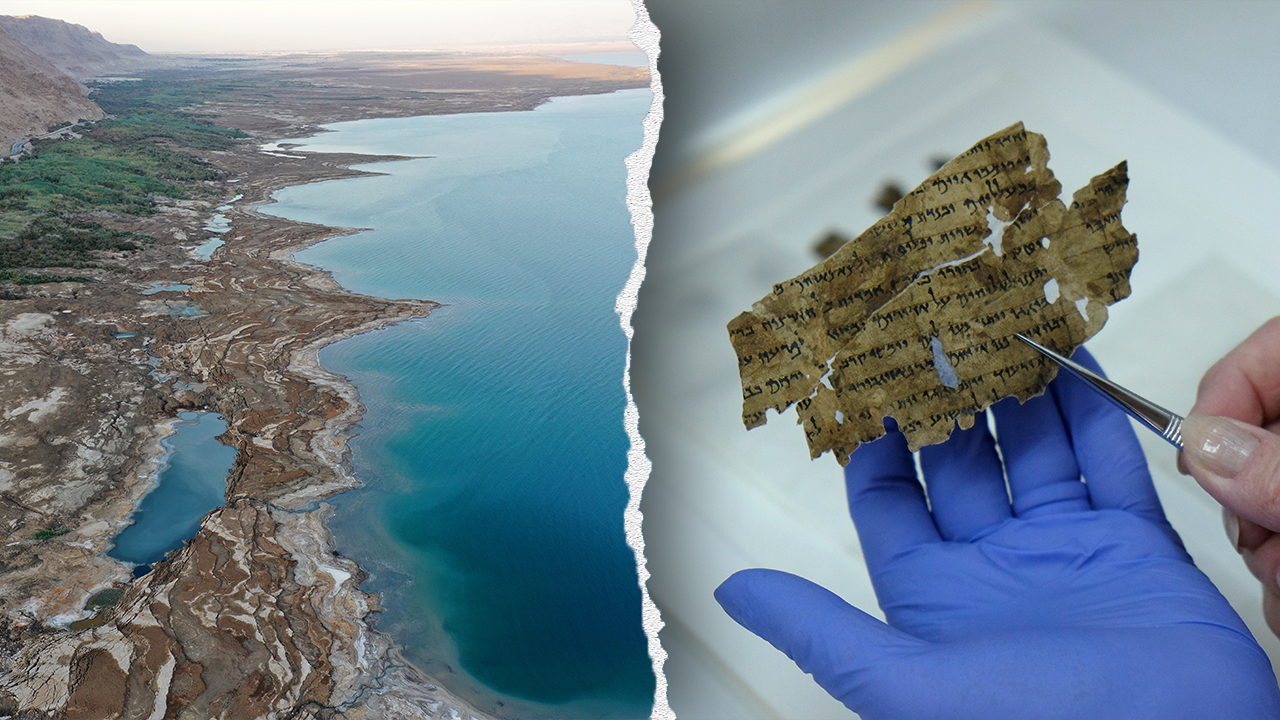
An argument for the antiquity of the Jewish claim to Eretz Yisroel appeared this week from a direction that rarely supplies one. Writing in Fox News, Loay Alshareef — a linguist, a senior fellow at the Macdonald-Laurier Institute, and one of the more visible Arab voices for the Abraham Accords — makes the case that the strongest answer to historical denial is not political at all. It is a cache of manuscripts that came out of caves above the Dead Sea.
Alshareef was born and raised in Saudi Arabia and is based in Abu Dhabi. His target is a specific claim: that Jewish attachment to the land is a recent invention, manufactured in Europe in the nineteenth or twentieth century. Qumran, he argues, makes that position very hard to hold. The manuscripts recovered there from 1947 onward, after Bedouin shepherds came across the first of them, were written by Jews living in that region more than two thousand years ago.
The part of his piece most worth the attention of anyone who learns is his insistence that the collection is not simply a very old set of Chumashim. Alongside the biblical manuscripts — the Great Isaiah Scroll among them — sit communal rules, tefillos, legal argument, hymns, wisdom literature and writings about the end of days. It is the working paperwork of a religious civilization rather than only its Scripture: how particular communities organised themselves, how they handled questions of purity, where they disagreed on law, what they expected of the geulah. That is the layer general coverage of the Scrolls almost always skips on its way to the photogenic parchment.
Alshareef's own reading runs somewhere else as well. As a Muslim, he writes, Yeshu belongs to his tradition too, and he is drawn to the Scrolls partly as a window onto the Second Temple world. Readers here will file that differently than he does. But the argument he builds on it is aimed squarely at his own side: the Quran is full of Bani Israel, Moshe is named in it more than any other prophet, and Muslims should therefore be the last people to erase Jewish history in order to make a case about the present.
His formulation for why the manuscripts carry the argument better than any advocate
could is that they are silent witnesses
— they take no part in the
debate, and they are not answerable to it. They record only that Jewish communities
lived in that land, copied Hebrew Scripture there and argued about its meaning
there, centuries before Islam and centuries before European nationalism.
He closes on something personal: he wants to do doctoral work on the Scrolls at the Hebrew University in Jerusalem, on their Hebrew and Aramaic and the communities that produced them. An Arab Muslim from Saudi Arabia studying ancient Jewish manuscripts in Israel is, he suggests, the kind of thing that peace actually consists of — not a document signed between governments, but a change in what people are willing to be curious about.
This is our own account of that column, written here. We have not reproduced it — read it at the source.